



Charlie Munger always encouraged investors to seriously consider the opposite point of view. To me, this is obviously a good idea. We humans have all sorts of behavioral biases such as anchoring, endowment effect, confirmation bias and overconfidence.
Well, at least you do. I am not at all overconfident. Just kidding!
Yet very few investors rigorously consider the opposite point of view before making an investment. Why?
I have my theories, but a couple of brief stories first.
Two attempts
Over a decade ago I was a senior member of an investment team at a large firm managing $20B+ in assets. We prided ourselves on having a rigorous process, which we did.
Part of it was having an analyst take about a month to research an idea and then present it to the group for discussion. The hope was that the ensuing debate would harden the thesis and serve as a quality check before an investment could make it into the portfolio.
Good plan, at least in theory. In practice, there was a huge asymmetry in how well the analyst doing the research knew the name vs. the other people in the room. I felt that we weren’t seriously stress-testing each thesis, at least not to our full potential.
So I made a suggestion: let’s assign a second analyst to do the Devil’s Advocate version of the presentation right after the primary analyst presents his. The second analyst wouldn’t have to take a month, but would get full access to the primary analyst’s data and take a meaningful amount of time to research the opposing perspective.
I thought this was a no-brainer. We were long-term, low-turnover investors. We didn’t need a lot of ideas, but we needed to be right and avoid losing money for our clients.
The head of the group, to my surprise, vetoed the idea.
Why?
He thought it would take too much time and slow down our productivity. Productivity at what?! Getting the wrong investments into the portfolio?
My second attempt came years later, after I had already gone out on my own and started Silver Ring Value Partners. I got a group of other experienced investors together and founded what I called the Devil’s Advocate Club.
The concept was simple: each member could request one Devil’s Advocate presentation a year, and also owed one if he were chosen to do so. I would coordinate the process and match a request with a member who would do it.
It worked for a bit. However, people’s work ethic was, shall we say, uneven. You would think that when someone commits to doing something for his peers, it would be too embarrassing to come up short. Yet, while some members took their obligations seriously, others said they would do a presentation and then never followed through.
Disappointing, but not completely surprising given the amount of work required. What was surprising was that the number of requests was pretty small.
Why it doesn’t happen
So here is what I think is going on:
Investors don’t want to lower their perceived productivity by doing work that doesn’t have any immediately obvious positive reward
People don’t want to lose face in front of others by having it pointed out to them how they might be wrong
Now, both of these are somewhat irrational. In a perfect world everyone should want to make the best possible decisions to achieve the best returns that they can.
Yeah, but we are human, so let’s get real: just because we know we should do something doesn’t mean that we will.
Where AI helps
Here is where AI can really help.
It works quickly. It doesn’t decide to welch on its promises. It doesn’t care about your title or hurting your feelings. You can have it destroy your thesis in private and not have to suffer any public humiliation.
Boom! Problems solved.
Except, you might say: “But bro, this will be just AI slop. Any young analyst could do a better job. It will hallucinate…” Yadda, yadda, yadda.
That would be missing the point. Don’t compare what AI will do with some hypothetical alternative that a) doesn’t exist and b) you won’t actually use.
Compare how useful the AI-generated Devil’s Advocate case is against what is likely to be your realistic best alternative in practice. And for most of you that alternative is: nothing.
So yes, AI will occasionally make mistakes. It will make up stuff once in a while (although that error rate is decreasing as models get better). It will miss things, but then again so will you and your non-existent junior analyst who isn’t actually going to be doing this work for you.
Despite all of those imperfections, I have found it to be very useful for a simple reason. It gets me quick, good-enough output for my use cases, which actually gets me to use it in practice.
I am sharing with you the Devil’s Advocate skill that I use in my own work. It’s quick and simple to install, and you can download it here. You will need a paid Claude plan with Research and web search turned on. If you need a refresher on how skills work and how to install one, AI for Serious Investors #1 covers that.
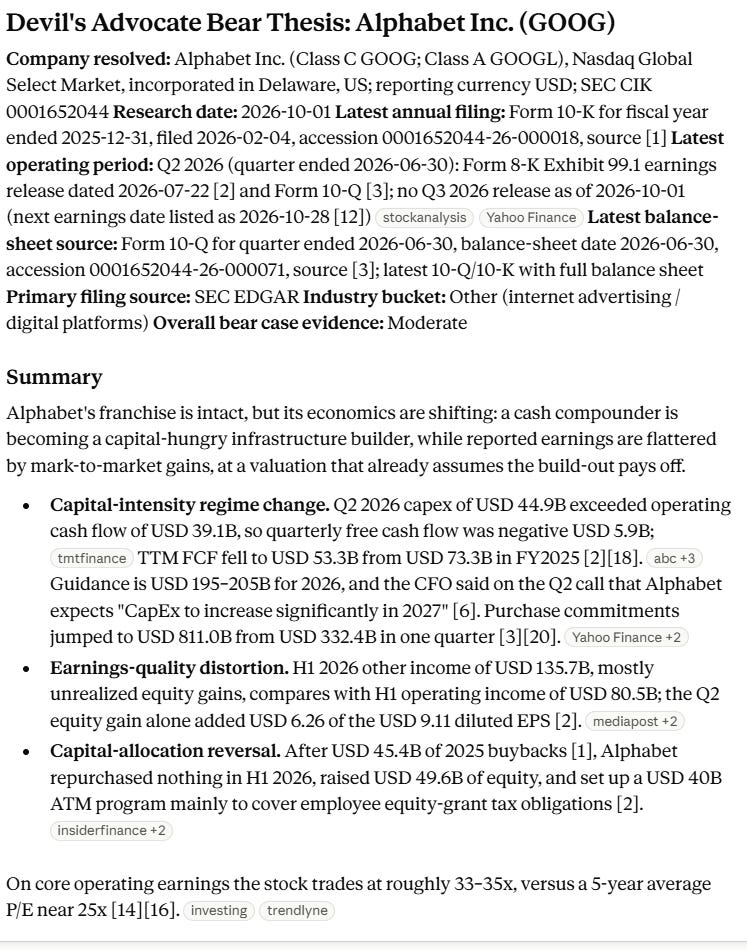
I just ran the skill as a quick test on Alphabet (ticker: GOOG). It finished in a little over 12 minutes and produced a useful result, which highlighted some of the key issues facing the company. Here is a snapshot of what the output looks like (the whole report is longer):
Three workflows
In The Toolkit, I split the first stage into Idea Generation (1a) and Idea Triage (1b), which is why you will see 1b below. Each workflow there also lists what you need to verify and where the skill’s job ends and your judgment takes over.
Here are three specific workflows for how I use the Devil’s Advocate skill in my investment process:
Workflow #1: Test a New Idea Before Committing to Deep Research
Process Stage: 1b: Idea Triage
How: Before doing deep research on a company, run the skill and read the report. You are looking to measure what you are up against if you were to spend your time doing substantial work. If there is a good chance that the company would fall into the “too tough” bucket, you can pass and move on to a more promising candidate.
Workflow #2: Build the Strongest Bear Case Before Acting
Process Stage: 3: Investment Decision
How: Same as workflow #1, except now you have done the deep research. Before making a decision, thoroughly review the Devil’s Advocate report. Search for any arguments that you haven’t fully addressed or research paths that you should have followed but didn’t. Only make the investment if you are confident you already have a good answer for any of the concerns raised; otherwise, go back and do additional research.
Workflow #3: Revisit an Existing Holding With a Fresh Bear Case
Process Stage: 5: Information Processing
How: Run the skill for each of your existing investments. Really ask yourself whether you are comfortable with the concerns the Devil’s Advocate skill discovers. If not, consider exiting the position or at the very least doing serious research to understand the issues better.
Look, there is no magic bullet in investing. There isn’t one thing that will make you money overnight. Investing is hard. When done well, it’s rigorous, systematic and disciplined. The Devil’s Advocate skill is a useful component of that process.
You can make such a skill yourself if you want to. However, I have already spent the time building and testing it (the first version was pretty bad), and as a paid subscriber you can just download it and start using it right away.
The best part is if you become an Annual subscriber, you get a 30-day full money-back guarantee.1 I don’t want to hold you captive, I want you to be excited to be part of the community because you are deriving substantial benefits from what I am making and sharing with you.
Even if you don’t want to use AI for this, I strongly encourage you to have some sort of Devil’s Advocate process that you follow. It will make your investing better, and even if it prevents just one big mistake that would have lost you a lot of money, the time will be well spent.
Until next time,
Gary
Disclaimer: Not financial advice, for educational purposes only. The Devil’s Advocate memo is research input; it does not recommend investments or tell you whether to change a position.
About the author

Gary Mishuris, CFA is the Managing Partner and Chief Investment Officer of Silver Ring Value Partners, an investment firm that seeks to apply its intrinsic value approach to safely compound capital over the long-term. He also teaches the Value Investing Seminar at the F.W. Olin Graduate School of Business.
100% agree that this is one of the best use cases of AI, and is very low cost and effort.