



I was mentoring one of my interns and we got on to the topic of what it means for a company to be ‘high quality.’ After all, that term frequently gets thrown around loosely by investors.
But does it have a single meaning? Is there a definition? Should there be? Or is it like U.S. Supreme Court Justice Potter Stewart’s famous line about pornography, that he knew it when he saw it?
I do think you should have a clear understanding of what you mean when you say a company is high quality. Presumably it’s an important input into your investing decision. Perhaps it is something you use to justify paying more for a stock.
So, yes, you should know what it means. More importantly, you should have a clear understanding of why it matters to you as an investor.
I have to confess. When I was a young analyst at Fidelity 25 years ago, I really didn’t get it. I recall asking more experienced investors questions like: “Why should we pay a higher P/E multiple for a high-ROE stock if that high ROE is already reflected in earnings being higher?”
Of course that misses the point.
As an investor, you presumably desire high quality in a company because of the benefits you expect that quality to offer you in the future. For investing, regardless of style, is always an exercise in assessing the future of a company.
That is true whether you are paying 5x earnings for the stock, or 25x.
After my intern took a couple of stabs at defining what high quality means, I paused and came up with my own definition. Later that day, I realized that I too had come up short. So I went on a hike through beautiful fall foliage in the Northeastern U.S., and spent an hour or so thinking about what the definition of ‘high quality’ should be, and why it matters.
Here is my definition of a high-quality company:
A high-quality company is one that
(i) has demonstrated attractive economic characteristics for its owners,
(ii) is expected to enjoy attractive owner economics in the future, and
(iii) has a low likelihood of unfavorable unexpected change to its economic characteristics.
You might, to paraphrase the character played by John Malkovich in the movie Rounders, feel very unsatisfied with this definition. It might appear vague. And how do you take it and use it to actually decide the quality of a specific company that you are considering?
It’s important to keep the definition general enough so that it is both true and survives the test of time. However, it’s also important to make it practical enough so that you can use it to make real decisions in your own investing. Let’s dive into what this means in practice.
Attractive Owner Economics
In business, capital is deployed in order to get a return. That return is best measured against the opportunity cost of capital. So when a company is funded with some mix of equity and debt, the first test of success is how the return on capital compares against the return investors would have gotten had they invested their capital in the same proportions in broad debt and equity markets.
At the risk of offending many a finance professor, I am going to oversimplify for our purposes here as the second-order nuances aren’t important for judging company quality. Historically, long-term U.S. government debt has offered about 6%, and U.S. stocks about 10%. Depending on the mix of debt and equity funding a company, that means the first-order approximation of most companies’ opportunity cost of capital is in the 7% to 10% range.
Since we are trying to decide if a company is of a high quality, we don’t need to get too precise. So the first question should be:
Question 1: Has the company historically achieved a double-digit Return on Invested Capital (ROIC)?
You might be wondering why I labeled the above as Question 1. As in, what else is there to it? Turns out, there is a lot more to it.
Consider two companies, A and B. Both have $100 of invested capital. Both earn a 15% ROIC, well above their cost of capital.
Except A is able to reinvest additional capital into the business at the same 15% incremental ROIC. B is only able to reinvest at below its cost of capital, so the only rational thing it can do is just return capital to its owners.
As an aside, being able to reinvest at high returns is only the opportunity. Management still has to take it, and at a company like B it has to send the capital back to owners instead of spending it on acquisitions that earn less than the cost of capital. So management always needs to be part of your company quality assessment.
Hopefully it should be clear that A offers its owners much more attractive economic characteristics than B, even though both have the same ROIC on the capital already invested in the business. So the second question is:
Question 2: Can the company reinvest capital into its business at an incremental ROIC well above its cost of capital?
Surely we are done here, you might think. Almost.
Let’s stick with our company A, which has a 15% ROIC and can reinvest capital back into its business at the same ROIC. Let’s say it can invest another $100 at that rate before it exhausts its superior investment opportunities and its incremental ROIC drops below its cost of capital. On the other hand, company C has all of the same economic characteristics as company A, except it can reinvest $1,000 at a 15% ROIC before it runs out of reinvestment opportunities.
Which company is more attractive to its owners? Of course it’s company C. Which leads us to our last question:
Question 3: How much capital can the company reinvest in its business at an incremental ROIC well above its cost of capital?
It should have become apparent to you as you think through these questions, that quality isn’t a binary characteristic. It’s a continuum.
An ideal company, of the highest quality, would therefore have a high ROIC well above its cost of capital on existing capital, have a high incremental ROIC on reinvestment opportunities, and would be able to reinvest a lot of capital at that high incremental ROIC.
Can a company be considered high quality if it fails one or more of these 3? Yes. Where should you draw the line? That’s for you to decide.
My threshold for a company to qualify as high quality is either a clear ‘yes’ to the first question, or failing that, a high-confidence ‘yes’ to questions two and three supported by evidence rather than merely forecasts. That company still has to clear the third part of my definition, which I explain in the next section.
Coming back to Justice Stewart, it turns out that we can quickly know quality when we see it. The best way to do this is by looking at Economic Profits over time.
Economic Profit (EP) = Invested Capital x [(ROIC) - (Cost of Capital)]
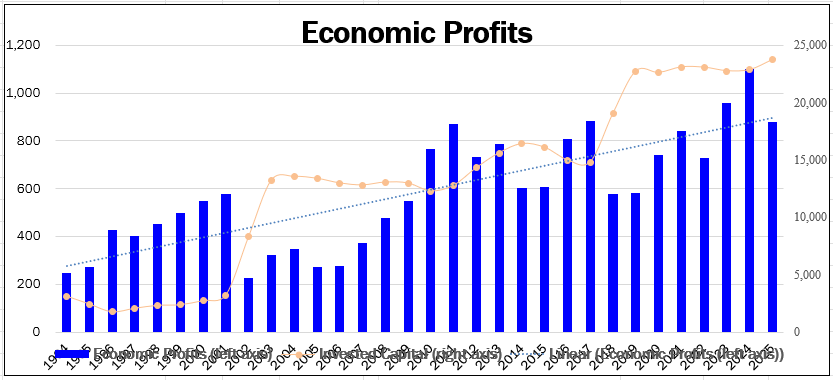
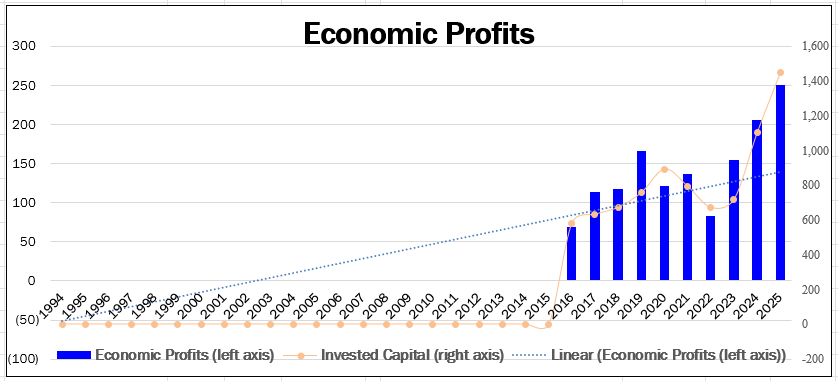
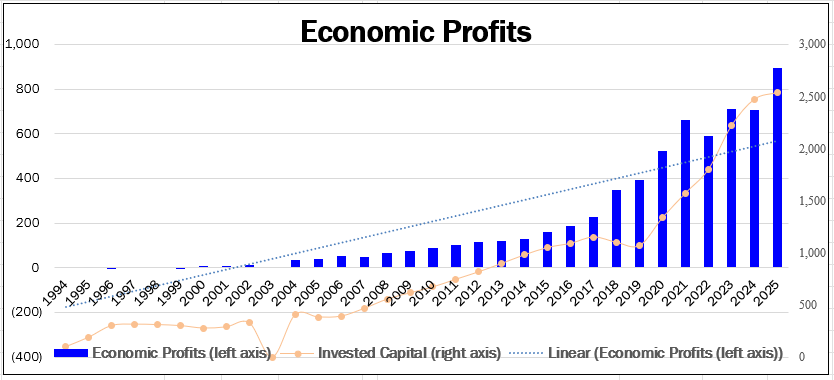
What are you looking for? Company B, the one with high ROIC but no good reinvestment opportunities, should have positive EP that’s steady. Company A should have positive EP that’s rising. And Company C should have positive EP that’s rising rapidly, rising over a long period of time, or both.
Here is what each of these would look like. The bars in the charts are Economic Profits, and the line is the amount of capital invested. These are based on actual companies with names removed, so that we don’t get distracted from the point of what to look for:
Company B:
Company A:
Company C:
There are 2 exceptions to these patterns that still qualify as high quality. The first is a cyclical company that averages a ROIC well above its cost of capital over a full cycle. The second is a younger company whose EP is small or negative today but turning sharply positive as it reinvests at high incremental returns. Anything else doesn’t clear the bar for me.
The Value is in the Future
You can’t buy the past. Well, maybe there is an exception to this in the sense that you can in terms of past profits that have been retained on the balance sheet. However, in most cases you care about the future owner economics of a company.
The value of a company is the Net Present Value of future free cash flows + any excess assets not used to generate those cash flows.
Why then do we even bother looking at the past? Because we believe that it, to some degree, helps us predict the future economics of the company.
Except it’s not as simple as it sounds, nor as straightforward as many investors make it out to be.
How will the future be similar to or different from the past? That’s a huge question well beyond the scope of a mere article on company quality. Many books have been written on this, practitioners have grappled with this question, and nobody has been able to get it 100% right.
That’s for the simple reason that the future is, by definition, uncertain.
Uncertainty isn’t necessarily a bad thing. Tell your kid that you will buy her anywhere between one and three ice cream cones and she will be pretty happy even though you just introduced some uncertainty into her future.
Nor does a mere negative change from the past necessarily make a company no longer of high quality. If a company were earning 30% ROIC and now you know, for sure, that it will ‘only’ earn 15%, then a) this is something that you can take into account in the price that you are willing to pay and b) this is still an excellent economic outcome.
The problem, then, isn’t either uncertainty or an expected decline in business economics. The problem is an unexpected deterioration in business economics.
Unexpected by whom? By you.
You are the one who is valuing the company. You are the one who is deciding how much margin of safety you want, in the form of the price you are willing to pay. So when you make an investment on the basis of one range of possibilities but unexpected developments cause the future to drastically and negatively deviate from your expectations, that can be a problem.
There are two ways to try to guard against that. The first way is to demand a really large margin of safety in the form of price. The second is to demand a really high-quality company, precisely because it should be far less likely to experience such unexpected adverse developments.
Those two defenses are tied together. The market frequently knows high quality when it sees it too, and it usually charges for it. Pay 35x earnings for a wonderful business and you have given up much of the first defense to get the second. If the unexpected does happen, you get hit twice: once by lower earnings and again by a lower multiple. The price matters, even for great companies.
No company is 100% immune from negative developments. However, some are much more at the mercy of chance, government actions, competitors, capital markets and many other factors. On the other hand, some companies control their own fate to a much larger extent.
I can’t give you a neat formula for how to quantify this. Besides, you don’t need a formula. What you need is sound judgment informed by business understanding and experience.
There are many existing frameworks that can help you with this, including Michael Porter’s 5-Forces analysis. However, be warned, they will be imperfect and still leave much to the skill of the practitioner implementing them.
I will leave you with these 5 (difficult) questions to ponder as you are trying to decide how likely a company is to experience unexpected negative changes to its economics:
What can cause the demand for a company’s products or services to permanently decline? How likely is that to come to pass?
How much time and capital would it take for someone to replicate the company’s value proposition to its customers? To surpass it in terms of cost, quality or both?
How likely is the government to act in a way that negatively affects the company’s business?
How dependent is the company on intellectual property or technology, and how fast can the pace of change in that technology be in the future?
To what extent does the path of economic or capital market cycles determine the success of the company?
If you have seriously thought about these questions, then it should become very clear to you why Warren Buffett likes buying branded consumer goods companies, such as makers of branded, habit-forming drinks or chewing gum.
Should you limit yourself to those? Not necessarily. But you better have a good answer to the above, and other, questions before you call a company high quality.
Conclusion
High-quality companies are in style as I write this in the fall of 2026. Yet too many people use the term loosely.
Identifying real high-quality companies is hard work.
It’s not just the historical financials. It’s not just the management or the story. It’s not just secular trends, technological changes, recent growth rates, or a myriad of other things that people substitute for real, thorough analysis.
It’s a combination of quantitative analysis and qualitative judgment, of the past, the present and a stab at what the future might look like.
It is a difficult analytical task that you can never complete with full certainty. Nevertheless, you can tilt the odds in your favor by being clear about what high quality means to you and how you will identify it.
If you get this approximately right, this will make you much more successful in investing than most.
Until next time,
Gary
Disclaimer: Not financial advice, for educational purposes only.
About the author

Gary Mishuris, CFA is the Managing Partner and Chief Investment Officer of Silver Ring Value Partners, an investment firm that seeks to apply its intrinsic value approach to safely compound capital over the long-term. He also teaches the Value Investing Seminar at the F.W. Olin Graduate School of Business.
Very insightful and a thought provoking article. I love that all these threads are captured in the PULSE framework. It re-emphasise for me the importance of the PULSE framework
The question of why a higher multiple for a high-ROE stock isn't already double counting is a good one, and the answer that quality matters for expected future benefits clears it up. Framing it as an assessment of the future rather than the past is the key point.