



You have heard the usual framing that investing edge is informational, analytical or behavioral. True, but the framework I am about to share with you is much more useful.
First, let’s define investing edge as a repeatable process advantage that should lead to better decisions than most investors.
The conventional wisdom tells you that edge exists in those 3 categories. That’s nice, but how do you get it yourself? That’s what I am about to teach you.
To develop sustainable investing edge, you need to change your perspective. Rather than thinking about investing edge by type, you should think about the steps of your investment process. Then, you need to engineer edge into one or more of those steps.
There are 5 broad stages to an investment process:
Idea Generation: determines what enters the funnel
Research: determines how accurately and efficiently you understand it
Investment Decision: determines how you convert analysis into action
Portfolio Construction: determines how much your best insights matter
Information Processing: updating stages 2 through 4 as reality changes
Each of these stages gives you an opportunity to add to your investing edge. Over time it is this edge that will lead to your excess returns.
Beating the market is very hard. Being deliberate about your investing edge is your best chance to succeed.
Idea Generation
To get an edge from idea generation, you need to either find ideas faster than others or find better ideas. Speed is important up to a point. If you get bogged down just generating a list of potential investments to look at, one of 3 things will happen:
You will never actually research or act on them
They will no longer be actionable by the time you get to them
You will give up and go back to using the usual sources for ideas that everyone else is using, which equals no edge at this stage
However, just being ultra-fast is not usually enough for an edge. What you need is to generate promising differentiated ideas in a reasonable amount of time.
There are 4 categories of differentiated ideas:
Exclusive - Available only to you or a small group. Think of top-tier VC firms like Sequoia who get first look at the best start-ups. Or think of a business owner wanting to sell to Berkshire Hathaway and nobody else because he cares about his employees having a permanent home.
Elusive - These are hard to find ideas that 99% of investors ignore. Maybe they are small special situations like spin-offs or restructurings. Or perhaps they are Phil Fisher-style compounders but in geographies that most investors don’t hunt in. You won’t read about them in Barron’s or the Wall Street Journal.
Repulsive - If most investors’ first impulse is to pass because an idea is too messy, then almost nobody is analyzing it even though it is in plain sight. Perhaps this is an ugly litigation with a lot of uncertainty. Or some kind of scandal - remember Buffett and the American Express salad oil scandal?
Misunderstood - I hesitate to include this category, because I don’t want you to think that it includes something like you thinking that Visa grows 1% faster than other people think. That’s not enough. I am talking about seeing a business completely differently than the consensus. Maybe everyone sees it as a money-losing operation, but you understand it to be a company with a very profitable core that is running a lot of organic reinvestment expenses through its Income Statement that are likely to pay off in the future.
You don’t have to have an idea generation edge. You can just say “OK, I will not have an edge at this stage of the process because my edge will come later on.” However, if you want an idea generation edge, it needs to come from one of these four categories, and in a reasonable-enough time to be actionable.
That’s why I have been using the 5-signal PULSE framework for over a decade to quickly get to the heart of an investment opportunity. The template allows me to dramatically increase my throughput and look at more ideas quickly without sacrificing quality. Combined with looking at a broad range of elusive and repulsive candidates, it adds to my investing edge from idea generation.
That’s also why I built the Claude-based Special Situations Screener skill. It allows me to systematically generate a promising list of special situations in several markets every month. It saves a ton of time and while nothing is perfect, I have found it to be good enough to find promising undiscovered special situations at scale.
A huge share of investor attention clusters around the same familiar companies. There is nothing wrong with studying them, but it is hard to build a sourcing edge where everyone else is already looking.
However, I have built an idea generation edge by systematically filtering promising ideas in corners of the market where most investors don’t look. You can do the same.
Research
Once you decide an investment candidate is worth a look, the next step is to research it. What’s the goal? It’s to:
Assess the company’s quality
Get the information necessary to build a reasonable range of outcomes for key economic variables
Establish a range of values for the security
At the Research stage, the conventional categories become useful inputs: informational and analytical edge are two ways to improve research output.
Informational edge is, literally, having useful information that few others have. No, it’s not referring to insider information. What we are talking about here is the mosaic theory - putting together pieces of publicly available or non-material information that together inform your view on an investment.
Some examples of where informational edge can come from:
Expert interviews. Several companies allow you to read a library of expert call transcripts or to request a specific type of contact that you can interview yourself.
Talking with competitors. You can call Company B and while talking with the CFO or the IR ask questions that will inform your view on your target investment, company A. Warren Buffett used to ask all of the CEOs in an industry the following question: “If you had a silver bullet to kill only one of your competitors, who would it be and why?” If 9 companies all want to ‘kill’ number 10, guess what? That’s probably a company that’s doing something pretty special.
Attending trade shows/industry events. Visiting a company is fine, but when you attend a trade show you can get much more unvarnished insight of what is happening in a market.
Be careful, there is a pitfall here. It’s tempting to want to know more about a company for its own sake. That’s a trap. It might make you feel better, but it’s not likely to lead to better decisions.
A story from when I was a young analyst at Fidelity comes to mind. The industry that I was assigned had a buyside analyst, a partner at a venerable investing firm across the street, who was always chosen as the ‘Best of Buyside’ by the Institutional Investor magazine. I was curious why, so I asked a sell-side analyst whom I knew well.
His answer: whenever he took a company on a roadshow and asked the CEO who knows them best, it was always that analyst that did. I was impressed.
Years later, I got to know the associate at that firm who had worked for that analyst. I asked him how much that analyst outperformed their benchmark over the long-term, since at that firm analysts also managed a portion of the assets by investing those funds within their assigned sector.
The answer surprised me: that ‘Best of Buyside’ analyst who knew more than anyone about the companies in their industry actually underperformed. More information is not always better. Sometimes it just gives you a false sense of confidence.
Analytical edge comes from synthesizing the same information better than most market participants. Some examples are:
Interpreting information differently through the lens of specific frameworks
Finding patterns in information that are useful and non-obvious
Adjusting financial statements to get closer to the true underlying economics of the company
Detecting patterns of accounting fraud in financial statements
Correctly identifying which few factors are material to the final conclusion and focusing on those
The Research stage is governed by the (Quantity x Quality) relationship. Quality is in turn determined by (Relevance x Correctness x Completeness).
Therefore:
Research Output = (Quantity x Relevance x Correctness x Completeness)
It’s here that judgement comes in. There is a tradeoff between increasing Completeness and increasing Quantity.
In practice, your research needs to be complete enough to not leave out anything material to change your conclusion, but not more than that. Going further lowers the number of companies you can research without meaningfully increasing the quality of your research.
If you can research 10 potential investments with sufficient quality in the time in which your competition can only do 5, you have an edge. Assuming equal caliber of candidates coming out from the idea generation stage, you are going to have a higher chance of finding a good investment.
Speed matters in researching potential investments. You can’t afford to waste a lot of time on ideas that you should have killed much earlier on in your investment process. On the other hand, you shouldn’t cut corners. If you get this step wrong, everything else will be wrong as well.
So, what’s the answer?
Automate what can be automated without sacrificing quality.
Do your research in the right order so that you can kill ideas quickly.
Invest your research time in a smaller set of investment candidates that have already passed through your initial filters.
Correctly getting to a quick no frees up your time and resources to research high-potential ideas.
Investment Decision
This stage has two components: (a) correctly deciding what you should do and (b) acting on that knowledge. You would think that they are one and the same, but they are not.
Think about dieting. You know what you should and should not do (e.g. you should eat veggies, you should not eat donuts). Does that mean that everyone always acts on that knowledge? No. Knowing what to do and doing it are different skills.
The goal of the Research stage is to give you the inputs to answer the question: based on my process, is this security an attractive investment? Making the correct decision at the Decision stage means mapping your analysis of the company and its security to a yes or a no.
To arrive at the right conclusion, you want an objective mapping between your research conclusions and your yes/no decision. This is not the place to introduce gut feelings or creativity into your process. You should have a clear set of rules that make sense to you based on how you invest.
This is a great point in the process for introducing a robust step to reduce behavioral biases. I like to use what I call a ‘Devil’s Advocate’ process to compare my budding investment case with a strongly articulated case for why it’s a terrible idea.
This is the right point in the process to rigorously stress test the idea. It comes before your conclusions have solidified and your confirmation bias is too strong.
On the other hand, it’s far enough in the process because you already have research and analysis of your own to compare against. So you are less likely to be incorrectly turned away from a promising idea by a scary-sounding case that nonetheless is insufficiently strong to rebut your investment work.
Using such a Devil’s Advocate process can be a meaningful source of investing edge. Few do it systematically. I had a senior leader at a prior firm tell me that it’s a waste of time because it reduces the number of opportunities we can look at. I don’t think so, not if your goal is to make the right decisions, rather than simply go through the most candidates.
That’s part (a). Part (b) is then acting on that decision. What are some reasons an investor might reach a conclusion that the security is attractive in stage (a) but then fail to act accordingly in stage (b)? Here are a few that I have observed in my over 25 years of professional investing experience:
Analysis suggests the security is attractive, but the investor is afraid of losing money because of adverse recent events or negative security price trends
The professional risk from investing is high because the idea is unknown or unconventional, exposing the investor to potential ridicule or negative career consequences if they invest and turn out to be wrong
The investor has strong behavioral biases that color his view and make him overrule his analysis
I don’t have an answer to the problem of a professional investor choosing to invest sub-optimally for his clients to benefit his own career or business. It’s a much thornier question than I can really address here.
However, we can combat the other issues on this list. One serious attempt is to create a deterministic mapping between the combination of quality assessment and valuation and whether the investment is a ‘yes’ or a ‘no.’
Importantly, if this rule says that the investment is a ‘yes’, it’s not an automatic buy. There are still important portfolio construction considerations to take into account.
Now, the output of your Research stage can be:
Quality, broadly defined
A range of intrinsic values for the security
Whether the security clears your minimum bar for investing
If done well, this lowers the likelihood of your being impacted by behavioral biases at the Portfolio Construction stage.
Portfolio Construction
Let’s say you have the same quality idea generation, research process and investment decision process as everyone else. You can still get an edge.
How? The first way is position sizing. For example, I recently made a successful investment, Warner Bros., that had a meaningful impact on the partnership. I wasn’t the only one who owned it, although there weren’t many of us given how out of favor the company was. However, it had by far the biggest impact on our partnership’s portfolio of anyone I know, because of sizing.
Research studies have shown that fund managers’ top positions outperform the rest of their portfolio. That means that experienced investors do have an idea about which are the best opportunities in advance.
However, not everyone has the courage of their convictions. Many investors don’t make their best ideas as big as they think they should deep down for fear of looking foolish, being blamed by clients, losing their job or their bonus, etc.
The other extreme is also a risk. There are folks who are so overconfident that they make huge bets on a single investment that they will not be able to recover from if they are wrong.
I usually hear folks like that quote Charlie Munger about having only 3 investments, or reference how Warren Buffett put half of his partnership’s capital in American Express during the salad oil scandal in the 1960s. What these investors forget is that a) they are not Munger or Buffett b) chances are the opportunity they are considering isn’t anywhere close to how attractive American Express was when Buffett made it his top position.
There is no one right level of concentration. It depends on many factors. However, there is a right level for you and your investment process in a particular market environment, and if you can get close to it that can be a source of edge since many investors will deviate widely from what is optimal for them.
The second way is correlation management. I am not talking about modern portfolio theory and managing how stocks wiggle together, or not, over short periods of time. I am talking about thinking deeply about what has to hold true for each investment to work out long-term, and making sure that being wrong on one or two key assumptions cannot sink the entire portfolio.
This is particularly important for concentrated investing. You simply don’t have the auto-diversification that someone closely hugging an index or owning hundreds of securities gets.
So, thinking about how the different pieces of your portfolio fit together under various scenarios over the long term can be an important source of edge.
Information Processing
A concept that most investors underappreciate is that investing is not one decision. It’s not even two decisions: the buy and then the sell. It’s a myriad of decisions that occur along the whole journey of an investment.
The concept is information processing. Each of our investments has a stream of new information or analysis that is available to us over time. Most of it is noise.
However, it’s not all noise. Having a systematic process for separating which developments should affect your thesis, and perhaps the investment decision or position size can be a meaningful source of advantage.
Many investors think of the investment process linearly. You generate an idea, research it, make a decision, and then construct the portfolio.
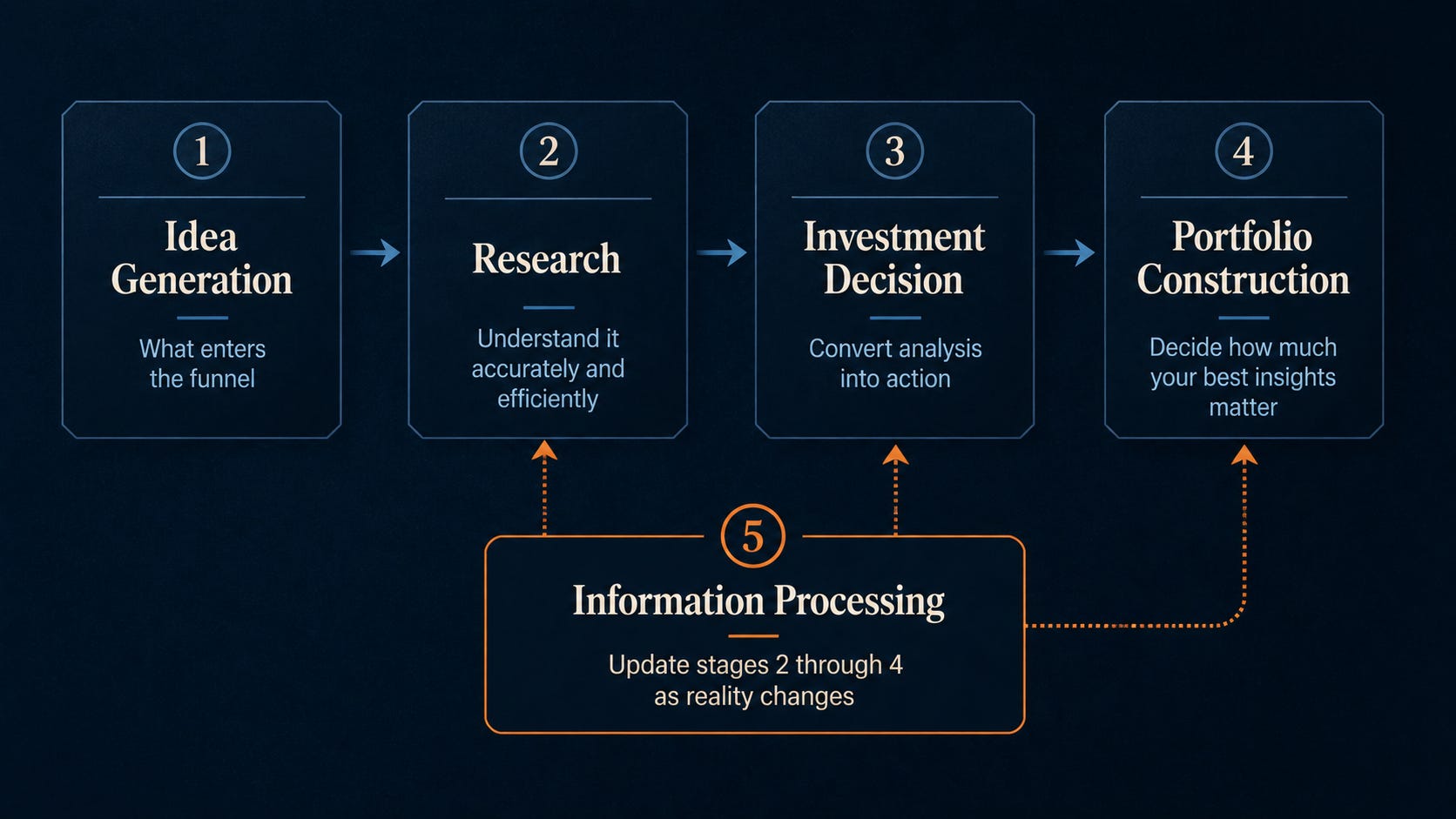
That framing is incomplete. Once a security is in the portfolio, new information and new analysis should trigger a continuous loop through Research, Investment Decision, and Portfolio Construction. The goal is not to react to every data point. Most new information is noise. The goal is to have a process for deciding which developments are meaningful enough to revisit the thesis, the decision, or the position size.
There are clear opportunities for an edge here, for example:
Having a robust loop at all, since most investors either don’t do it or do it haphazardly
Choosing the right inputs as signal vs. noise
Correctly deciding the right degree of effort that still gets you to an appropriately correct decision without using up so much time and resources as to be impractical
Here are some ideas of how you can engineer an edge at this stage:
Define a threshold which requires you to re-analyze an investment from scratch. For example, it could be your investment thesis not tracking for a certain period of time or with a certain severity. I use a formal thesis tracker to tell me when to trigger this step for each company that I own.
Periodically start with a clean sheet of paper and the most current version of your Research stage for each of your holdings. Construct a new portfolio without looking at your current weights. Then compare the two and act if warranted.
Systematically run a Devil’s Advocate research process at a certain time interval on each holding to make sure your research and conviction are not stale.
Conclusion
Classifying investing edge as informational, analytical, or behavioral is correct as far as it goes. It is just not the most useful way to actually build one.
A more practical approach is to break your investment process into stages and ask where you are deliberately trying to be better than the marginal investor competing with you.
You do not need an edge everywhere. You probably cannot have one everywhere. What you can do is be explicit about where your edge is supposed to come from, then build workflows, rules, tools, and habits that increase the odds that the edge actually shows up in decisions.
A simple exercise may help. Take out a blank page and write down the five stages:
Idea Generation
Research
Investment Decision
Portfolio Construction
Information Processing
Next to each stage, answer three questions:
Do I have a real edge here, or am I just hoping that I do?
What specific workflow, rule, tool, habit, or constraint creates that edge?
How would I know if it is working?
For some stages, the honest answer may be that you do not have an edge. That is fine. The danger is pretending. Once you know where your edge is weak, you can decide whether to build it, partner around it, avoid competing there, or make sure your edge comes from a different stage.
This is what I am trying to do as I keep iterating on the investment process at Silver Ring Value Partners. It is also what I am trying to help you do here at Behavioral Value Investor.
Most investors do not lack opinions. They lack a deliberately engineered process for turning their strengths into repeatable decisions. The question is where, exactly, your process is designed to create an edge.
If this article helped clarify your thinking, please restack it to help others.
Disclaimer: Not financial advice, for educational purposes only.
About the author

Gary Mishuris, CFA is the Managing Partner and Chief Investment Officer of Silver Ring Value Partners, an investment firm that seeks to apply its intrinsic value approach to safely compound capital over the long-term. He also teaches the Value Investing Seminar at the F.W. Olin Graduate School of Business.
Good read Gary, thank you.
I think you've touched on a bit but figured I'd make the point more directly. The Devil's Advocate process is not just useful for the Research and Decision phase, but also directly informs the Information Processing phase.
In other words, if you think through how you might be wrong in advance and what metrics will tell you that, you can then be alert to the signposts that will confirm or refute your hypothesis, making your future decision making easier.
This approach addresses one of the realities of research and decision making - not everything is knowable at the time of investment. So it can sometimes be more productive to say "I don't know", and then give yourself a framework to efficiently cut a position if the evidence comes back against you. I say this from the perspective of realizing that cutting the losers that I will inevitably invest in sooner is something that has really helped me improve as an investor, and therefore increase my returns.
Really enjoyed this framework, Gary. Breaking edge down by process stage rather than edge "type" is a much more actionable way to think about it — and forces an honest audit of where your process actually has (or doesn't have) an advantage.