


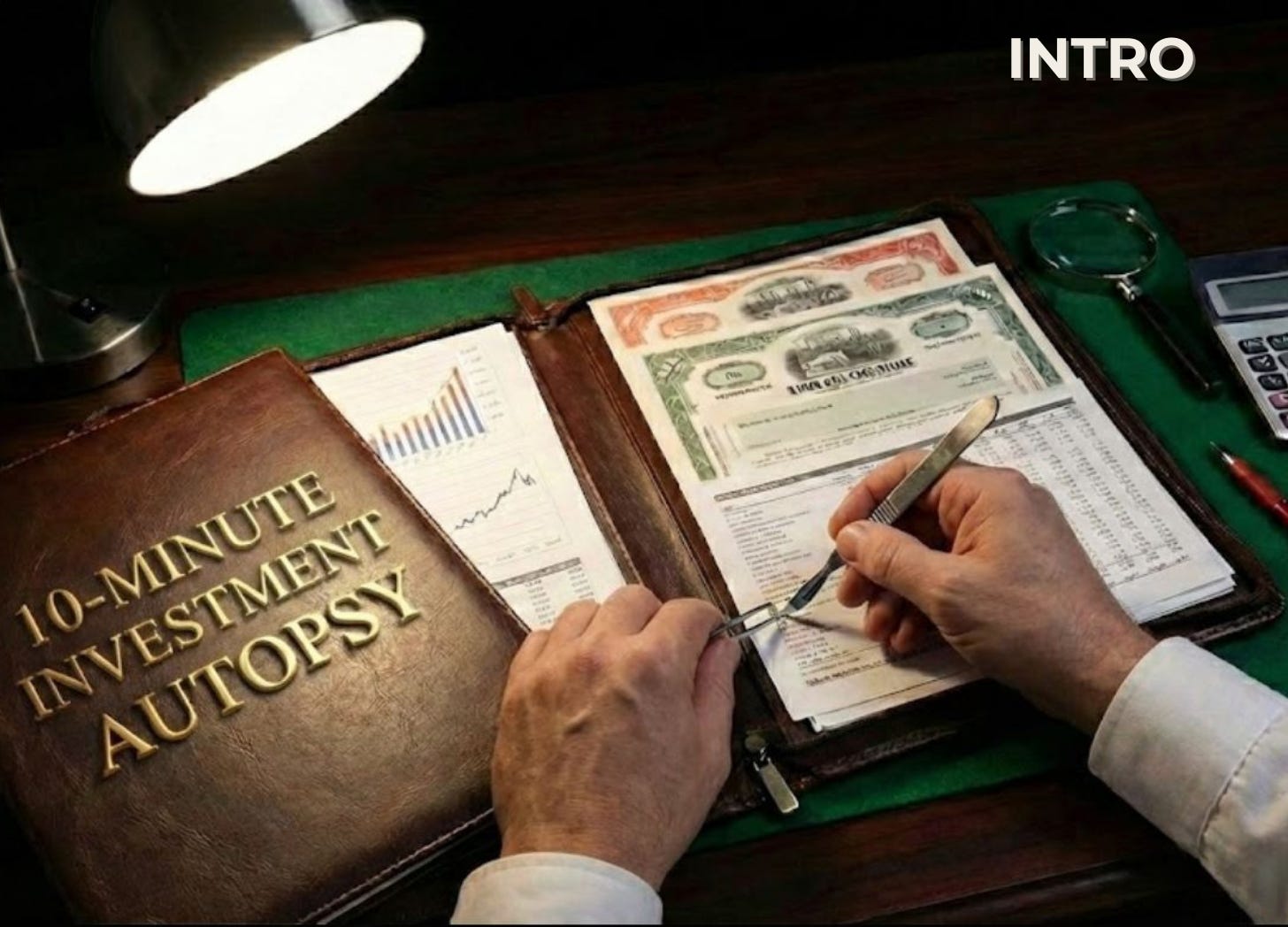
I am launching a new weekly series to help experienced investors improve their process by studying past mistakes and successes of master investors in a time-efficient manner.
Published Cases
The Why
You have read the investment classics. You have started investing real money. Or perhaps you are an experienced investing professional. How do you continue to improve?
Reading more theory? Helpful, but soon you will encounter diminishing returns. There are only so many times that you can hear abstract concepts and have them improve your investing process.
Studying from your own mistakes and successes? That’s good. However, that’s a limited sample. Besides, don’t you want to avoid some of those mistakes or not miss out on some of those successes before the fact?
Institute a regular process of reviewing successful and unsuccessful investments within your investment organization? Great idea, but good luck keeping the politics out of that process. Trust me, I spent 15 years at large investment firms before going out on my own and starting Silver Ring Value Partners 10 years ago. If you are an individual investor who is serious about improvement, then this is not even an option.
This is where this series comes in. I took the idea from studying chess, where it’s common practice for intermediate and advanced players who know the basics to progress via studying master games annotated by a strong player. This way you are exposed to many more real-world examples than you will encounter in your own practice, and with insightful commentary you can take the lessons you learn and use them to improve your own “game.”
The What
Your time is valuable. The plan is to squeeze the maximum useful lessons into a short amount of reading, about 10 minutes.
I will select investments made by experienced investors, usually with 10+ years of experience. Unless unusual circumstances warrant otherwise, the investments will be at least 5 years old to allow time to see how they worked out.
There will be a mix of those that worked out well and those that failed. The main criterion is that there was a clearly articulated thesis which we can then mark to reality.
The How
We will start by reviewing the original thesis. This sets up the investment case as it existed at entry: who invested, what the idea was, the source, and a brief summary of the reasoning.
Next, we will analyze what happened, focusing on just the facts. How did the business perform? How did the stock do over a 3, 5, or more years?
The autopsy will analyze why things unfolded the way they did: what did the investor get right, what went wrong, and why.
Finally, we will extract the lessons from this investment case that you can incorporate into your own investing. These might be process lessons, or behavioral lessons.
We will conclude with a discussion question for you to think about and for us to discuss together in the case-study thread.
How You Should Use the 10-Minute Investment Autopsies to Improve
To maximize your improvement, try to read each case as it comes out. Pause after the investment thesis has been articulated, but before you find out what happened. Try to ask yourself questions, such as:
Do I agree with the thesis?
What are logical flaws, either of commission or of omission?
What biases, if any, is the investor potentially exhibiting?
What are factors that might interfere with the investment case?
One last thing. The goal is to learn, so keep in mind that in investing, as in chess, master investors still have a significant minority of their investments not work out. Please don’t take what I write as in any way a criticism of the person or as an attack on their competence as an investor. My only intent is to extract useful lessons so that we can get better together.
As a serious investor, if by regularly reading this series you avoid even a single investing mistake or invest in one successful opportunity that you would have missed, the impact will be many times the cost.
A Request
Whether you are interested in this series or not, if you have gotten value from reading the Behavioral Value Investor in the past, can you please do me a favor and help me spread the word? I would really appreciate it if you would restack this post to help others discover this opportunity to learn and share it with friends or colleagues who you think would benefit.
About the author

Gary Mishuris, CFA is the Managing Partner and Chief Investment Officer of Silver Ring Value Partners, an investment firm that seeks to apply its intrinsic value approach to safely compound capital over the long-term. He also teaches the Value Investing Seminar at the F.W. Olin Graduate School of Business.
I was really looking forward to reading these, pity they are behind a paywall.