



I bet you did not think that you can do everything “right” in planning for your retirement and still run out of money. You can save diligently. Invest prudently. Spend according to conventional wisdom. And yet a good portion of the time you might run out of money unless you understand how things really work.
You see, average returns only tell you so much. Sequence matters quite a bit.
Take the same average return assumption and if you start with a big market crash upfront your money will run out a lot sooner. That’s why the typical retirement calculator is just not good enough if you want to be secure in your retirement.
Speaking of returns, let’s start with what returns you can reasonably expect from this point for a typical retirement timeframe of 30 years. Conventional wisdom is that U.S. equities have generated long-term returns around 10%.
True. But not all that helpful. Why? That’s because we are starting from way above-average starting valuation. Here is how this impacts returns:
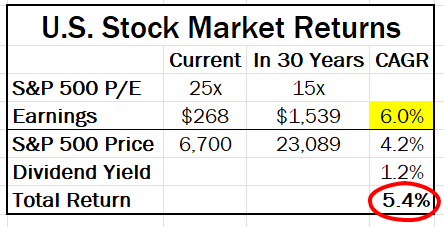
Whoops. It looks like from this point forward the likely returns, even over a period as long as 30 years, are likely to be a lot lower than the historical average.
But OK, you say, “Gary, I don’t agree with your return assumption. I am going to do a lot better than that.” Excellent. I don’t know for sure what the returns will be, but neither do you. So what’s the solution?
You should stress test your retirement across a range of scenarios. After all, you don’t want to leave something as important as retirement to, literally, chance.
How can you do that? Well, the usual online calculator lets you enter just the average return, but that is not enough. So I have built a tool that I use in my own planning, the Wealth Simulation Tool. It let’s you use a sophisticated statistical technique used by institutions, the Monte Carlo Simulation, to test how your retirement plan holds up in the many possible paths that the future can take.
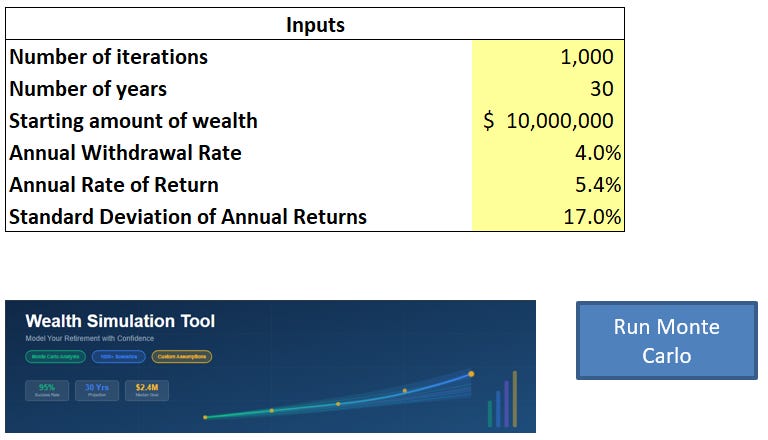
You start by entering your assumptions:
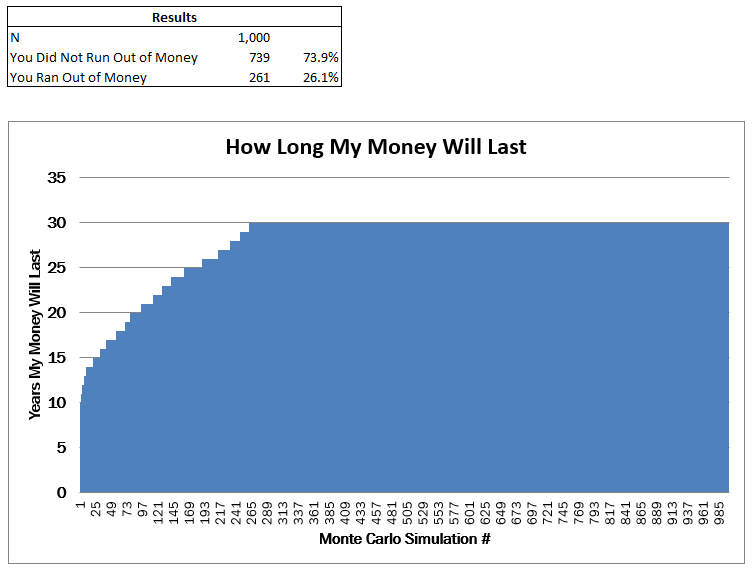
Then you click the “Run Monte Carlo” button, which after the computations are done gives you a simple to understand output:
Disagree with my assumptions? Have different circumstances? Great. I am sharing my Wealth Simulation Tool with you for free so that you can do your own planning.
🎁 Download your FREE Wealth Simulation Tool
Happy planning,
Gary
Think someone in your network would benefit from this? Restack to pass it along.
About the author

Gary Mishuris, CFA is the Managing Partner and Chief Investment Officer of Silver Ring Value Partners, an investment firm that seeks to apply its intrinsic value approach to safely compound capital over the long-term. He also teaches the Value Investing Seminar at the F.W. Olin Graduate School of Business.
Interesting.
Which distribution did you assume for the returns?