



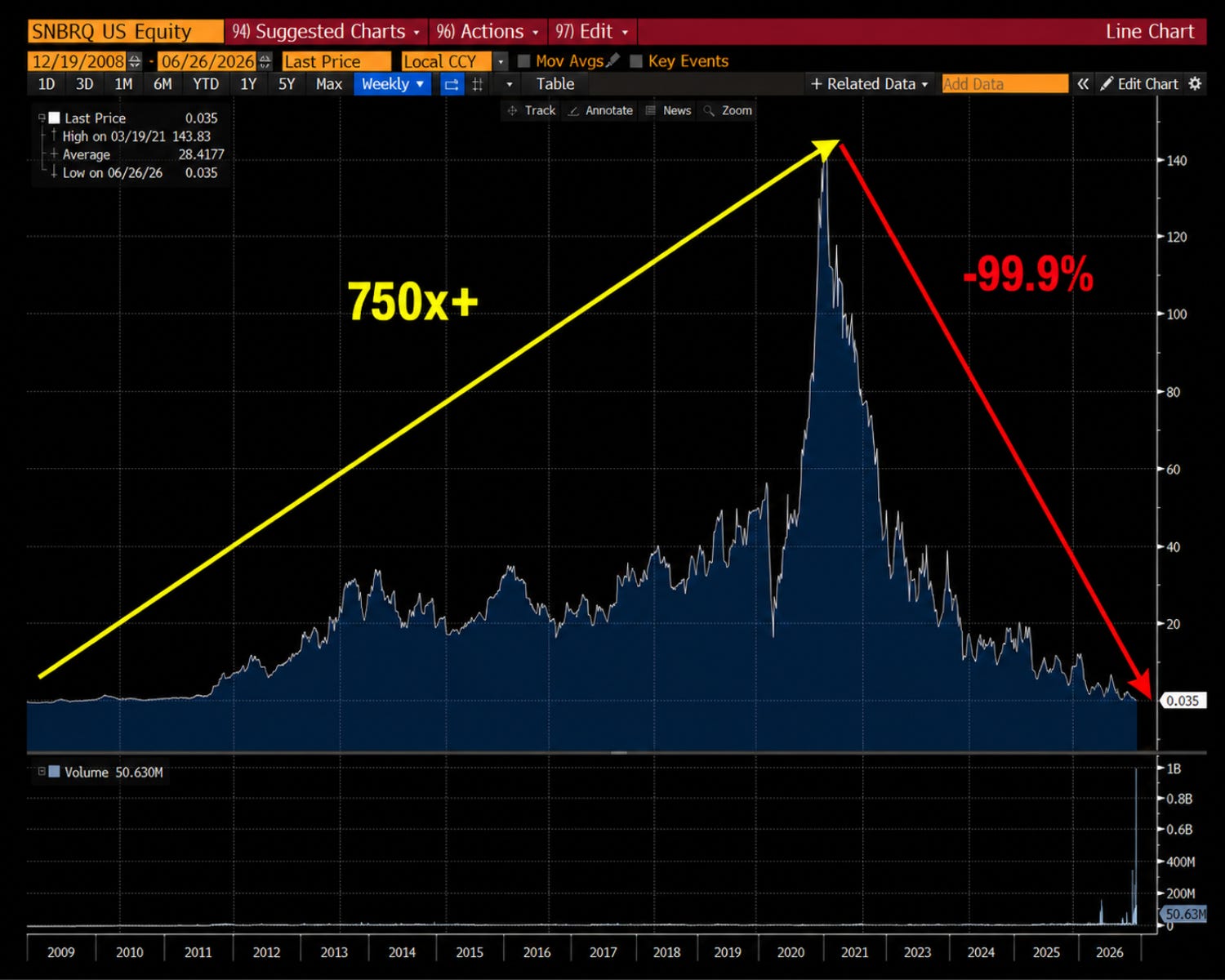
On December 19, 2008, Sleep Number’s stock price bottomed at 19c per share. The company was on the precipice of bankruptcy. Debt was high, cash was scarce, and the auditors attached a going-concern qualification to their opinion.
On March 19th, 2021, the company’s stock was trading at $143.83 per share. That’s a return of 750x+ over 12 years.
I covered the story of how Shelly Ibach, who became CEO in 2012, helped turn the business Bill McLaughlin had pulled back from the brink into a massive winner in Investment Autopsy #20. In this article, I dig into how Sleep Number came to the brink of failure again, only a few years after that March 2021 high.
Only this time, it didn’t stop at the brink. The company filed for bankruptcy on June 12, 2026, and its stock now trades at just 3c per share:
The company’s fall, surprisingly, started with blockbuster growth. In 2020, in the midst of the COVID pandemic, sales growth came in at 9%. In 2021, it accelerated to 17%.
Store count expanded from 611 at the beginning of 2020 to 648 by the end of 2021 and then to 670 by the end of 2022. Comparable sales growth was 6% in 2020 and 17% in 2021. Profit margins expanded by around 2% over this two-year period.
How could such great results lead to the company’s downfall?
Greek tragedies follow a certain pattern. A key component is that the hero’s hubris carries the seeds of their eventual downfall. And a management team that had presided over an amazing turnaround that had resulted in a 100+ bagger was particularly vulnerable to hubris.
Management interpreted this inflection in demand not as a purely cyclical phenomenon, but rather as a deserved validation of its long-term strategy. For example, on the Q4 2020 earnings call, the CEO said:
Consumer trends that we have long anticipated were accelerated by the global pandemic in the past year, resulting in three structural shifts.
First, consumers are prioritizing well-being, their own and that of their families, and they now better understand the strong link between sleep and overall health and wellness.
Second, consumers are adopting digital products and services at a much higher rate, and they are increasingly relying on digital health solutions.
And third, consumers have a heightened preference for brands that are characterized by authentic purpose and human empathy. Each of these shifts is enduring, driving permanent changes in consumer purchase behavior.
With our strategic investment in sleep science-based innovation, digital technologies, and brand accelerators, we are positioned to continue taking market share and delivering superior stakeholder value in this transformed environment.
In other words, management didn’t perceive this acceleration in sales growth as being caused by a cyclical pull-forward in demand. Management’s language suggests they treated the pandemic demand surge as confirmation of their strategy, rather than as a warning that some demand had been pulled forward.
Assignment of credit was not the only implication of interpreting this new level of demand as structural. It also drove management’s views on investing and capital allocation.
Speaking of capital allocation, what would you do if you were the CEO of a company and believed:
The business was structurally improving due to management’s brilliant strategy
The acceleration in demand was sustainable
Management’s prior actions had already led to massive stock price appreciation over the prior decade
You guessed it, you might be tempted to buy back a heck of a lot of shares. Not as an empty signal of confidence, but as a reflection of your genuine belief that the shares were a lot more valuable than the market was giving them credit for being.
That’s exactly what Sleep Number management did:
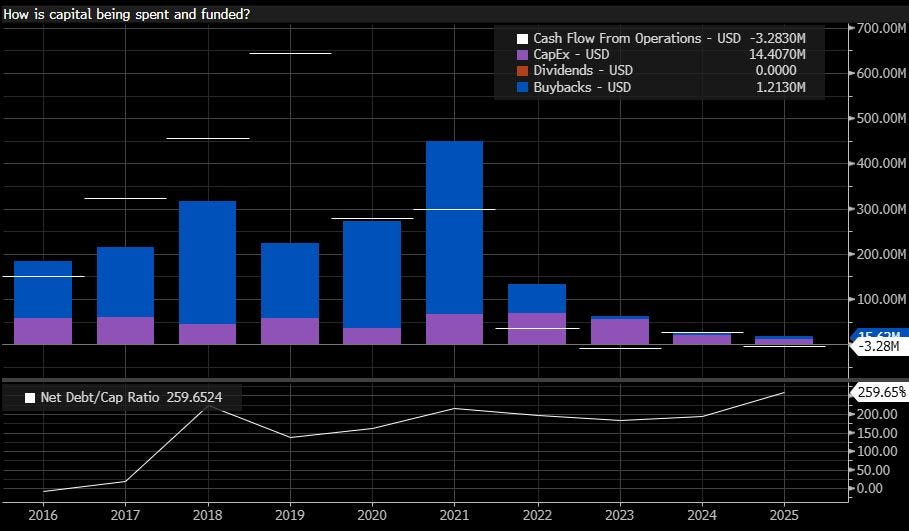
The company repurchased over $1.5B in shares between 2012 and 2022
This included more than $630M between Q4 2020 and Q1 2022 at an average price of around $90 per share.
You might think that the 2020 and 2021 share buybacks were just business as usual. After all, as you can see from the blue bars in the chart above, they have been buying back shares for a while.
The leverage problem did not begin in 2020. Debt had already risen sharply before COVID. The 2020-2021 period was the final and most damaging phase, when management doubled down near the top of the cycle.
This might have been fine had management’s assessment of the facts been accurate. However, reality had other plans…
In 2022 comparable sales declined 6%. In 2023, they declined 12%. And in 2024 they declined another 10%.
Over that time frame, EBITDA margins got cut in half, from 12.7% in 2021 to 6% in 2024.
Ominously, the company had a cumulative negative free cash flow of around $100m over that period. Net Debt to EBITDA spiked to nearly 5x.
What happened?
Turns out, the jump in demand in 2020-2021 wasn’t mainly consumer recognition of management’s superior strategy and company positioning. It was mostly an old-fashioned cyclical demand pull-forward.
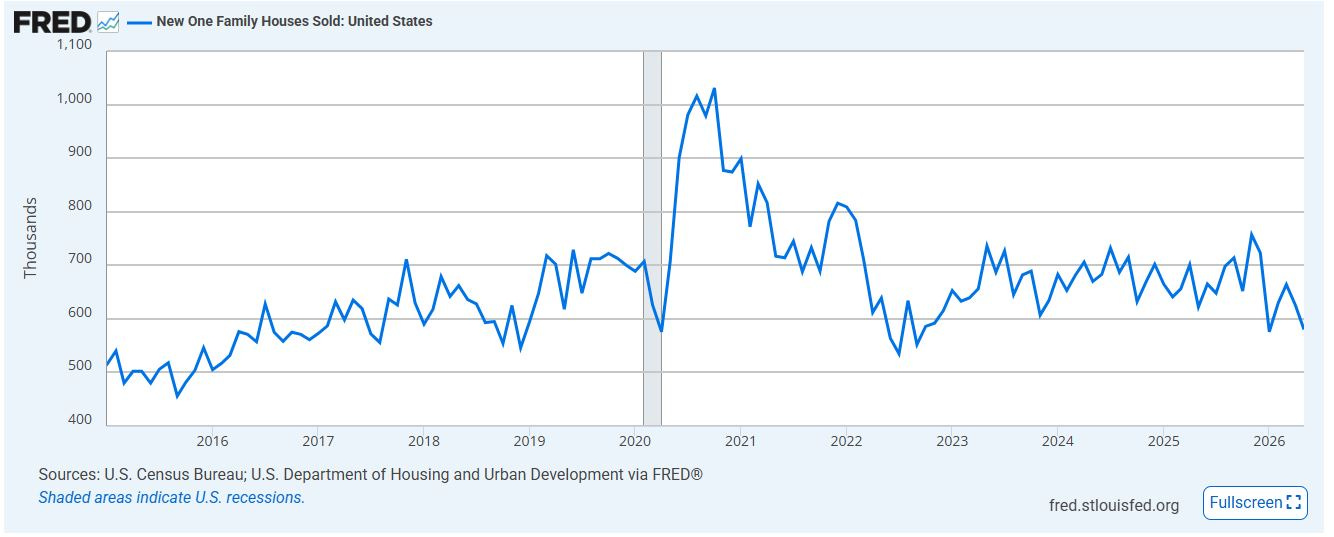
COVID naturally boosted consumer demand for houses. After all, if you are surrounded by people any number of whom can have a deadly virus, what could be more rational than to want to get away from them into a house of your own?
As you can see, both existing and new home sales spiked in 2021-2022 and then sharply declined thereafter:
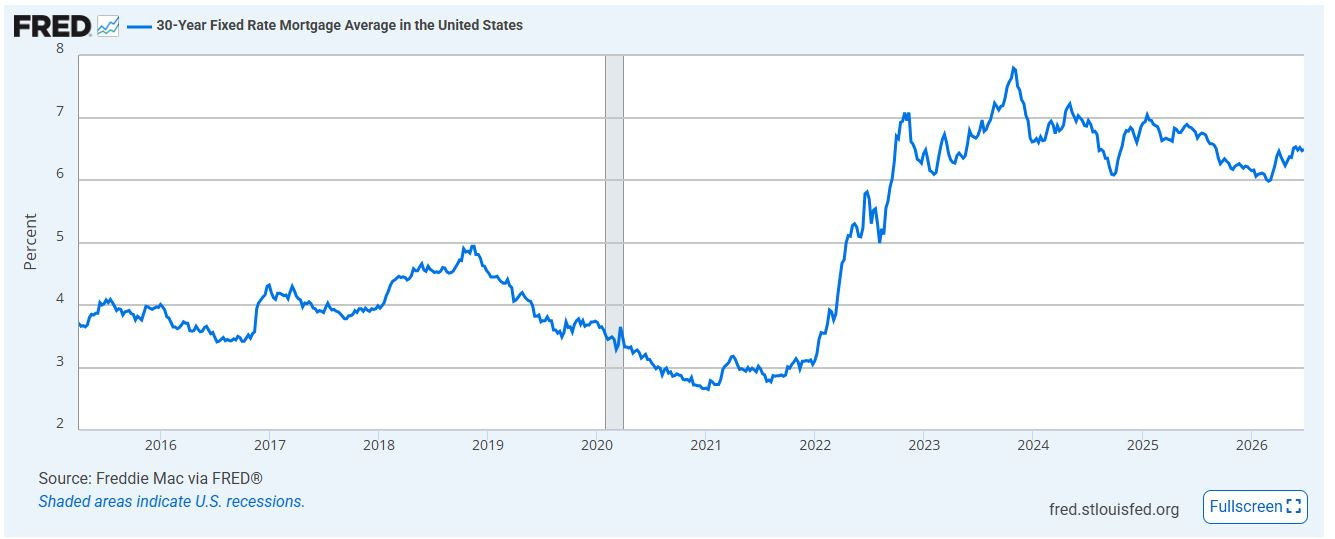
Of course, it didn’t help that ultra-low bond rates, and by extension mortgage rates, normalized upwards shortly after the COVID pandemic:
The underlying rise in inflation, in addition to contributing to higher mortgage rates, also reduced consumer disposable income and their ability to purchase and finance high-ticket discretionary items:
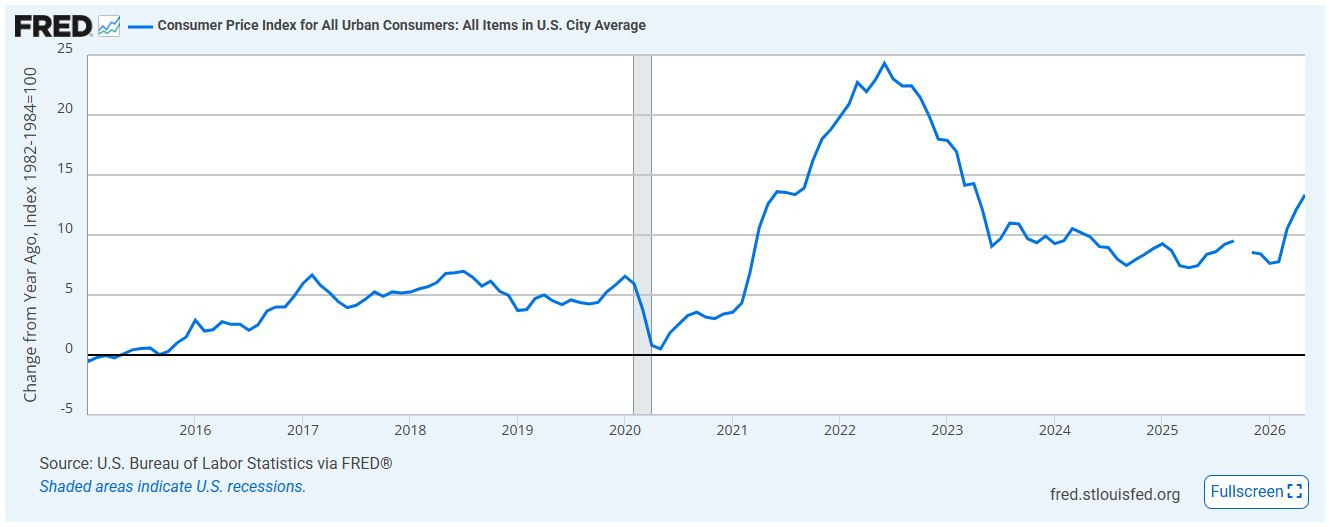
A large share of Sleep Number’s sales relied on promotional financing through Synchrony. Higher rates not only hurt consumers but also raised the cost of subsidized financing.
Finally, the microchip shortage in 2022 disproportionately hurt the company given that it used them in its smart beds whereas competitors selling plain old mattresses did not.
Management was quick to blame external forces for the carnage.
CEO, Q1 2022 Earnings Call:
The start of the war in Ukraine in late February, combined with a sharp increase in gas prices and broad-based inflationary pressures, affected consumer shopping behavior in March, including demand for our smart beds.
CEO, Q2 2022 Earnings Call:
Economic conditions for consumers have deteriorated throughout the year. The annual inflation rate accelerated to more than 9% in June, the highest level since 1981, and nearly half of U.S. consumers now say that inflation is eroding their standard of living.
Consumer sentiment plummeted to record low levels in May and June, with declines across all demographic segments. Correspondingly, our demand for the second quarter declined 12% versus the prior year.
CEO, Q4 2023 Earnings Call:
Low consumer sentiment, slower new home purchases, and elevated interest rates continued to pressure demand for our category. Additionally, consumer purchasing power continues its steady downward trend.
We estimate that mattress units in 2023 were below 2015 levels and down more than 25% from their 2020 peak.
Gone were the days when management talked about a permanent structural shift in consumer demand for their product due to their innovation and branding.
Not everyone was so forgiving. In late 2023 an activist investor, Stadium Capital Management, got involved. After their cooperation agreement expired in 2024, they issued two scathing letters detailing their perception of management and board misdeeds. They were also instrumental in pushing out the CEO who presided over the rise and fall of company’s fortunes.
They made their opinion of the board clear in their November 2024 letter:
While shareholders cannot trust the current Board to hire Sleep Number’s next CEO, we also believe that shareholders cannot trust this Board, which is still populated with many long-tenured directors who presided over a truly colossal destruction of shareholder value, to oversee the crucial capital allocation decisions facing the Company.
A meaningfully reconstituted Board will be better positioned to identify a great CEO, create the best incentives for that CEO and instill long overdue accountability into Sleep Number’s corporate culture, all of which would help unlock the tremendous value that exists within this Company. It is well past time to put an end to this relentless and extraordinary value destruction, and fix Sleep Number’s leadership and governance.
They got their wish for a new CEO, but unfortunately it was too late. In March 2025 the board named a new CEO, Linda Findley, who attempted to turn things around.
Linda did cut stores and costs, but she inherited a balance sheet with very little room for another demand shock. By then, the question was less whether the business could be improved and more whether creditors would give it enough time.
Saddled with a pile of debt and depressed demand, she was unable to boost profits sufficiently to avoid tripping covenants and appease the banks supporting the company via the revolver.
On the Q4 2025 Earnings Call she summarized the situation:
Finally, let’s talk about liquidity and capital structure. It isn’t news to anyone that we need to fix our capital structure. I knew that when I joined the business less than a year ago, and it remains our top priority.
Three things hit us particularly hard in the end of 2025 and beginning of 2026. The industry-wide softness we already spoke about our work to clear out inventory as we roll out the new product line, and our continued careful management of marketing spend as we lap a very high inefficient spend of Q1 last year.
This puts pressure on our liquidity, and we are implementing a plan to address this. As part of that plan, we hired Guggenheim Securities to evaluate the inbound interest we have received and advise on other opportunities to refinance our credit facility as we shape Sleep Number back into a profitable, growing company.
Unfortunately, on June 12, 2026, the company filed for Chapter 11 bankruptcy listing $642M in assets against $1.3B in liabilities including $672M in debt.
The Lessons
When demand changes rapidly, it’s important to seriously consider the degree to which the reasons are cyclical, and therefore temporary. Shelly’s public comments suggest she viewed the rapid spike in demand in 2020 and 2021 largely as validation of the company’s strategy. While there might have been some benefit from that strategy on the improving results, she would have been wise to consider that her competitors were seeing similar rapidly improving results, suggesting that a large portion of what was going on was temporary.
Levering up the balance sheet is always a risky strategy. It is particularly so when the business is cyclical and you are near the top of the cycle. Of course, nobody tells you where the top is in real time. However, if business is going really well, your stock is flying high and there is not a cloud on the horizon, it’s dangerous to increase financial leverage. It is especially baffling that this board of directors, many of whom presided over the company’s near-death experience in 2008-2009, fell into this trap. Perhaps they thought that if they survived it once they could do so again. Unfortunately, every cycle is different and if you introduce financial fragility into the company, it might not come out on the other side of the cycle.
It is very hard to combine greatness with humility. In some ways, perhaps it doesn’t make sense to be too humble if you have been doing a great job as the management team over a long period of time. However, the best management teams can combine deserved pride in their success with a healthy measure of paranoia that prevents them from resting on their laurels.
The final lesson is the simplest one of all, but perhaps the most profound for investors. Any series of numbers multiplied by 0 is still equal to… 0. It doesn’t matter what your returns were, if you kill the company all the shareholders get wiped out.
If this case study was useful, please restack it so another serious investor can learn from it.
Paid subscribers to Behavioral Value Investor get regular case studies, investing frameworks, and AI tools for improving their research process. Please consider subscribing.
Disclaimer: Not financial advice, for educational purposes only.
About the author

Gary Mishuris, CFA is the Managing Partner and Chief Investment Officer of Silver Ring Value Partners, an investment firm that seeks to apply its intrinsic value approach to safely compound capital over the long-term. He also teaches the Value Investing Seminar at the F.W. Olin Graduate School of Business.
This case underscores the critical importance of differentiating between cyclical demand surges and secular growth. While the initial pandemic-driven demand was cyclical, the management's misinterpretation led to overconfidence and poor capital allocation. Investors must remain vigilant in identifying whether growth is temporary or structural, as the latter requires a different strategic approach and risk assessment.