


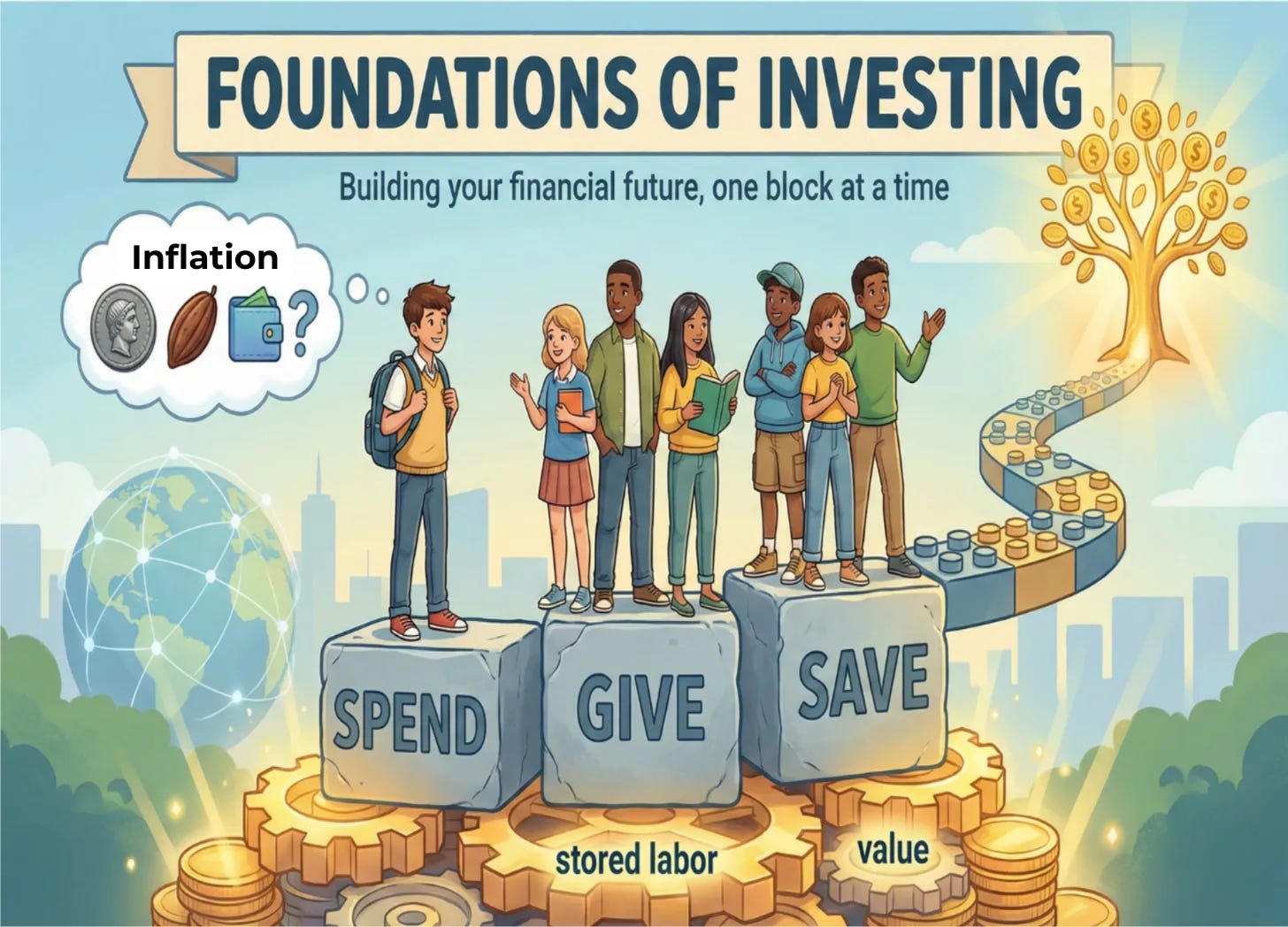
Introduction to Foundations of Investing
If you recall from Foundations of Investing: What Is Money? this series is inspired by my desire to help my almost 13-year-old twins understand the basics of money and investing in a way that is approachable and useful. If you are just starting out and want a solid foundation to understand how to handle your money, you are in the right place.
Can Money Rot?
Recall our farmer analogy from What Is Money? and how we talked about the use of money to replace bartering directly between farmers that produce different products. Remember how we said that unlike eggs, money does not rot?
Well, that’s technically true. Physical money, whether it is made of metal or special paper, is designed to last a very long time.
However, there is a way that money can ‘rot’ in a sense – it can lose some of its purchasing power. In other words, you will still have the same amount of money, say $1,000, it will just buy fewer eggs, milk or bread than it would have before.
Your money will not have rotted physically, unlike milk or eggs that are kept too long, but because of inflation and the reduced amount each dollar is able to purchase, the effect will be just the same.
A Brief History of Inflation
Inflation is almost as old as time. Throughout history, rulers and governments have periodically wanted more money than they had. Sometimes it was because of war and their need for more resources. Other times they just wanted to spend what they didn’t have.
Examples include:
England’s Henry VIII reduced the purity of silver coins in the 16th century, a process called debasement, from the 92.5% sterling standard to as low as 25%.
During the Russian Revolution of 1917 and ensuing years, the currency lost almost all of its value as the victorious Bolsheviks (as the Communists were called then) printed a huge amount of new paper money to try to finance their needs.
In Weimar Germany of the early 1920s, hyperinflation, a term that means extremely high inflation rates, caused prices to double every 3.7 days. Workers would sometimes receive pay that would be nearly worthless by the time they got home to spend it.
In case you think that inflation is a thing of the past, current examples of very high inflation include Turkey and Argentina.
Regardless of the reason, the result was always the same: more money, or debased money, led to abnormal increases in prices. So, the money that people saved, if it was simply lying around, lost some of its purchasing power, sometimes a little and sometimes all of it.
Inflation in the United States
In the U.S., the Federal Reserve was created in part to ensure price stability. However, as anyone trying to stick to a regimen of healthy diet and exercise knows, discipline is hard.
Politicians always face the temptation to “buy” votes by spending money that they don’t have. Expecting them to behave otherwise is a bit like putting a selection of delicious desserts in front of a hungry person and hoping they won’t help themselves. It’s just not realistic.
Originally, economists and Federal Reserve governors interpreted price stability to mean zero inflation. That view gradually changed to a range of 0% to 2%. Then somehow 2%, instead of being the maximum, became the goal. As I write this in 2026, the Federal Reserve is struggling to achieve even that modest goal, with inflation persistently staying above 2% for years.
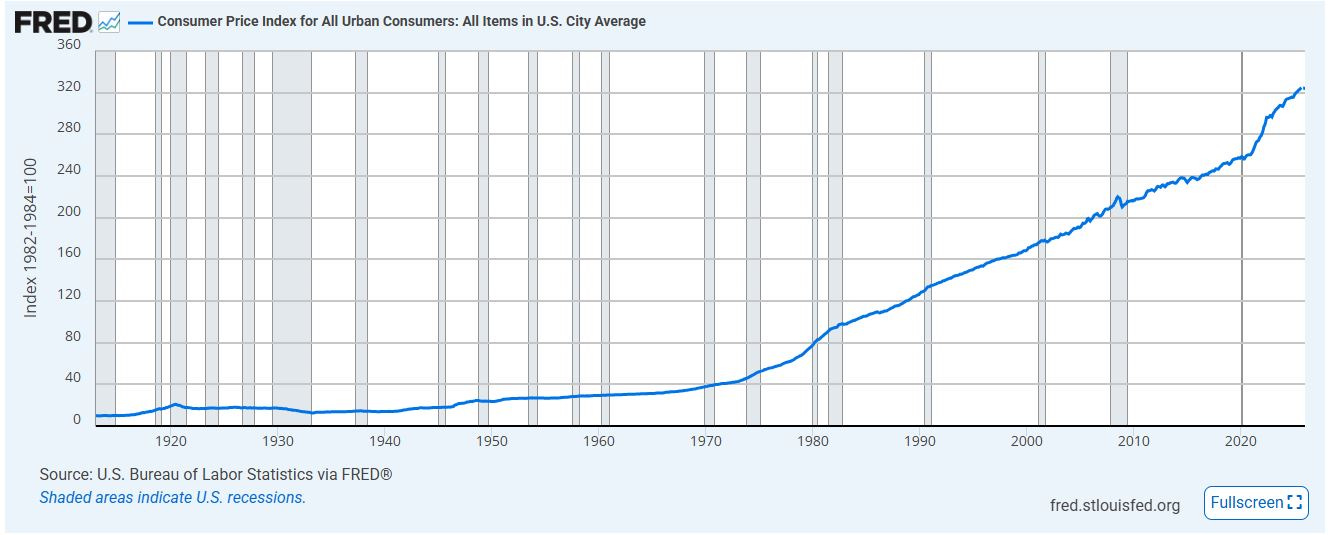
This is not at all unusual. After all, between 1913 and 2026 inflation, as measured by the Consumer Price Index for All Urban Consumers increased at a rate of 3.1% per year:
When the Federal Reserve was established, the U.S. was on something known as the Gold Standard. That meant that each paper dollar was backed by gold reserves. In theory, a holder of any paper notes could walk into a bank and demand to exchange his paper for actual gold.
Gold is hard to find and its stockpiles grow slowly. That is one of the reasons that it has been used as money in so many societies across history.
The consequence of that scarcity is that it limits politicians’ ability to spend as freely as they would like. So, in the 1970s, a government that swore it wouldn’t take the U.S. off of the gold standard… took the U.S. off of the gold standard.
From then on, paper dollars were no longer backed by gold and could be printed as freely as the U.S. government desired, subject to some checks and balances.
The 1970s showed what lack of discipline could lead to – inflation rapidly accelerated and peaked above 10%. It required a lot of sacrifices and a severe recession to get it back under control.
Conclusion
What does all this mean for you? Imagine someone who worked hard in 1913 and saved $1,000 in wages for retirement. Had that person decided to put that money away under their mattress, 60 years later that money would have had the purchasing power of less than $325.
Now let’s imagine a person saving $1,000 in 1966, intending to use it for retirement 60 years later. The purchasing power of that money in 2026 would be less than $100.
In both cases, this hardworking saver would have been robbed of most of the benefits of his savings because of the policies of the government. If anything, the rate at which dollars seem to lose purchasing power has gotten faster, which is worse for savers.
The logical conclusion is that you need some way to save money that allows it to at least keep up with inflation. Otherwise saving for the future is going to actually cost you quite a bit.
The Least You Should Know
Money can and very likely will lose some of its purchasing power over time.
History is full of examples of severe inflation, but even modest inflation over a long enough period is dangerous if you just put your savings under the mattress.
The answer is not to stop saving and spending everything you have right away, but to find a way to save money that allows it to at least keep up with inflation.
Coming Up Next
If protecting your money from inflation is so important, then how can you do it through investing?
Do you know any young folks, or their parents, who could benefit from the Foundations of Investing series? Please share this article with them to help them get a solid financial foundation early in their life.
Disclaimer: Not financial advice, for educational purposes only.
About the author

Gary Mishuris, CFA is the Managing Partner and Chief Investment Officer of Silver Ring Value Partners, an investment firm that seeks to apply its intrinsic value approach to safely compound capital over the long-term. He also teaches the Value Investing Seminar at the F.W. Olin Graduate School of Business.