



One way to greatly improve as an investor is to study the investing greats and put their styles and investment processes through the understand, apply, and customize framework. The goal is to help you develop the best investing style and process for you.
Therefore, let’s dive a bit deeper into what makes an investing style. As you study the masters, it would be helpful if you could do more than just say, “Gee, I like how he does that,” and get more specific about what you might want to incorporate into your own approach and what you would rather leave out. The framework I like to use for this is dimensions of an investing style.
Think of a dimension of a style the way you would think of an x- or y-axis in geometry. Each dimension is independent of the others. There are many dimensions, and far more possible investing styles based on the various combinations of “values” along each dimension.
There are many valid ways to combine how a style is positioned on each dimension. However, not every combination is equally rational. Let me explain with an example.
Let’s take two dimensions, Diversification and Depth of Research. Of course, dimensions have a continuum of values, but for the sake of simplicity let’s assume that each of these can take one of two values:
Diversification: Very Diversified or Highly Concentrated
Depth of Research: Shallow or Deep
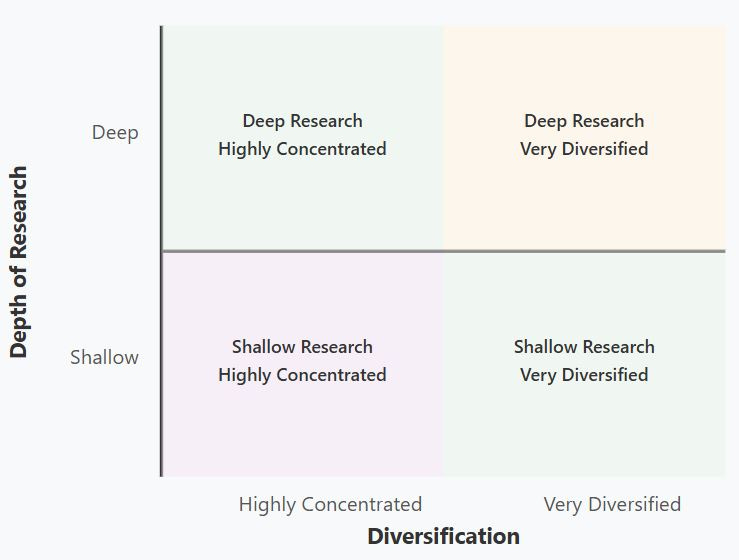
Let’s think through each of the four combinations:
Deep Research, Highly Concentrated: Makes perfect sense — if you are going to concentrate, you better know your investments well.
Shallow Research, Very Diversified: Also very rational — if you know each investment just superficially (e.g. a valuation statistic only), you best diversify broadly.
Deep Research, Very Diversified: On the surface this might not make sense, but it could. For example, imagine a large firm with an army of analysts. Each analyst could have a lot of depth on a small number of investments and the portfolio manager could construct a diversified portfolio out of their ideas.
Shallow Research, Highly Concentrated: This one makes no sense and would be a recipe for investing disaster.
The point is that while there are many valid ways to combine positioning along the different dimensions, there are also invalid combinations. Many things go, but not everything does.
Here are 21 dimensions of an investing style that will help you better comprehend investing greats and ultimately build your own investing approach:
Depth of Research (shallow to deep)
Portfolio Concentration (concentrated to diversified)
Quantitative vs. Qualitative
Business Analyst vs. Security Analyst
Time Horizon (short to long)
Investing Universe: Asset Class
Investing Universe: Market Cap
Investing Universe: Geography
Investing Universe: Sector Focus
Absolute Return Focus vs. Relative Return Focus
Risk Tolerance (low to high)
Bottom-Up (micro) vs. Top-Down (macro)
Financial Leverage (no debt to any)
Growth Rate (any to high)
Activism (passive vs. active)
Focus on Earnings vs. Assets
Technical Analysis vs. Fundamental Analysis
Reversion to the Mean vs. Escape from the Mean
Management Interaction (none to detailed)
Primary Research (none to in-depth)
Long Only vs. Long/Short
When you study an investor you want to learn from, break down their style among these dimensions. Think deeply about why they chose to position themselves where they did. Which of those reasons sound compelling and apply to your own situation? By going through this process with multiple master investors, you will not only understand their approach better, but you will also begin to develop your own investing style crafted around your strengths and circumstances.
Want to greatly improve your own investing? It’s not too late to join the free Value Investing Seminar and join a community of long-term investors who are trying to grow and improve.
If you found this article helpful, please consider restacking it to grow our community of like-minded investors.
About the author

Gary Mishuris, CFA is the Managing Partner and Chief Investment Officer of Silver Ring Value Partners, an investment firm that seeks to apply its intrinsic value approach to safely compound capital over the long-term. He also teaches the Value Investing Seminar at the F.W. Olin Graduate School of Business.
Could you please elaborate on the Business Analyst vs. Security Analyst dimension?