



In AI for Serious Investors No. 1, we covered what Claude Skills are, how to install them, and you got the Special Situation Screener Skill to improve your idea generation. In this article I am going to share a simple but surprisingly useful Skill that builds out a structured Company Overview PDF deck in minutes.
Quick Note: As a way of saying ‘Thank you!’ to all of you, I am making this article and the Skill download 100% free.
In my 5 Sources of Investing Edge article, I covered the stages of an investment process:
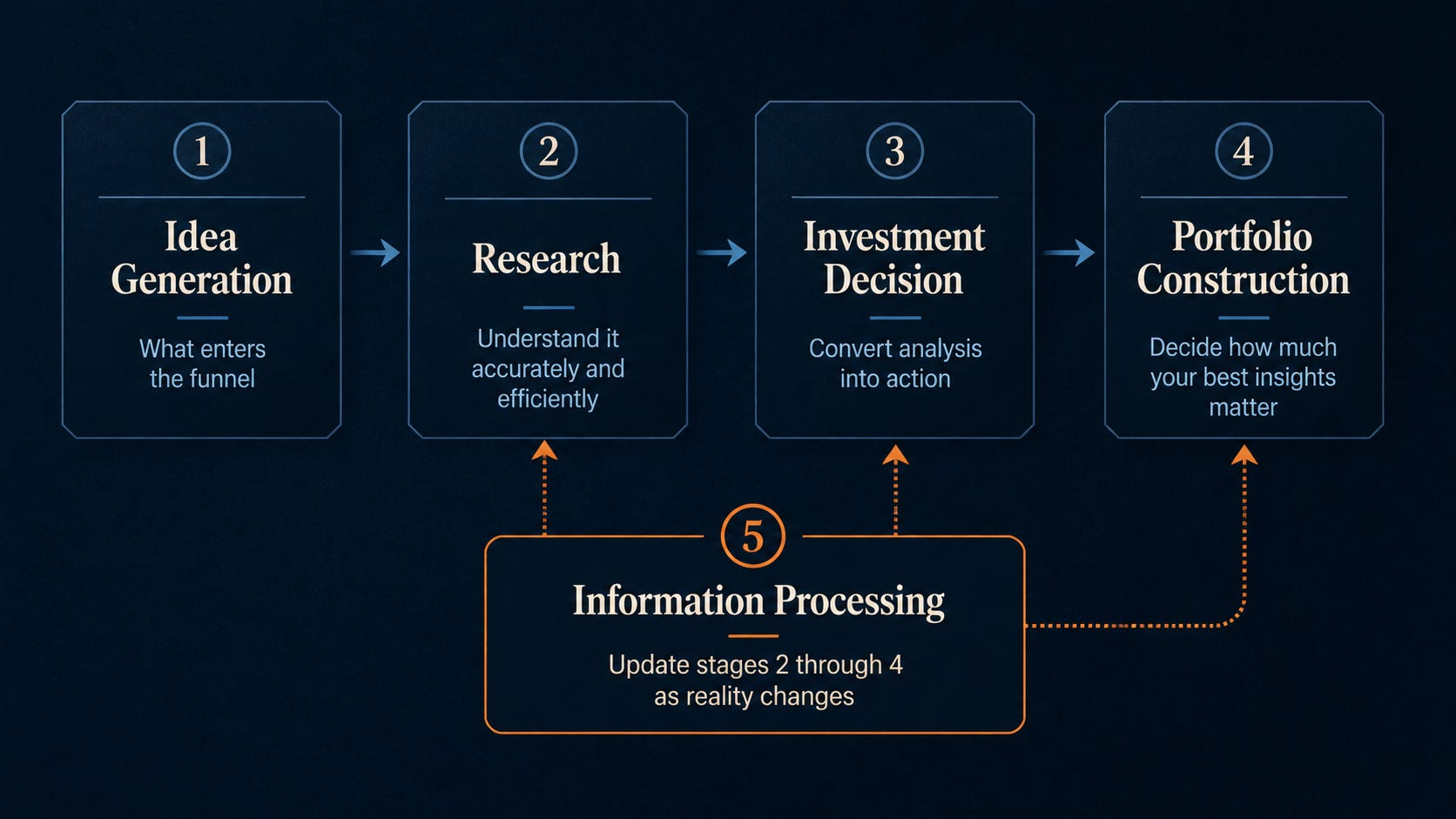
Each AI resource that I release will be classified into one or more of the 5 investing process stages: Idea Generation, Research, Investment Decision, Portfolio Construction and Information Processing.
This system will let you quickly understand where an AI tool fits in and whether you want to use it in your own work. Without further ado, let’s get to today’s Skill.
Company Deck Skill
Investing Process Stage: Early Research / Late Idea Generation
Technical Savvy Required: Low
Pre-requisites: Claude subscription, works in web browser
Expected Time: about 15 minutes per run
This Skill creates a structured company overview deck in PDF format. It’s a great way to quickly get to know a company that you are thinking about researching further.
You can use it at the tail-end of the Idea Generation stage to decide if a seemingly promising candidate is worth further work. Or this can be the jumping-off point for a stock you already decided to research and now want to build your plan.
It follows the following structure:
Slide 1: What does the company do? What goods/services the company sells, to whom, and how it gets paid.
Slides 2–4: Company history - How the business evolved over time. Acquisitions / divestitures made. When and why management changed.
Slide 5: Industry & Porter’s 5 Forces - summary. Describes the company’s primary industry and summarizes the Porter 5 Forces analysis.
Slides 6–10: Assessment of each Force and how it has changed over the last few years.
Slide 11: Competitive Advantage Does the company have it? What is it? How big/small? How has it changed over the last few years?
Slide 12: Management Incentives (e.g., proxy-statement compensation section), how long they have been in place, how much stock they own.
Slide 13: Balance Sheet How levered is it?
Slide 14: Biggest Risks The biggest risks to the company for an investor who would own the stock for at least 5 years.
Slide 15: Next Steps - The research path recommended for a long-term investor to verify these conclusions, deepen understanding, and gain mastery sufficient for a thorough quantitative and qualitative understanding of the business.
The best part?
A. The Skill works surprisingly well and consistently in our own testing
B. You should be able to easily modify the structure of the slide deck to whatever fits your own process
Download the Company Overview Skill here. Use this 100% off Discount Code to get it free, no payment info required once you enter the code near the bottom and hit ‘Apply’:
Discount Code: YZMDK4NQ
Conclusion
I have a full pipeline of other AI-related tools that I am excited to share with you in future articles, so stay tuned!
Two disclaimers:
AI can (and probably will) make mistakes. I tested these Skills and use them myself but sometimes a) a run may abort due to technical issues or b) some of the info can be off. I have found these cases to be rare and an acceptable cost of using tools that most of the time work well. You will have to make that tradeoff decision yourself.
This is not investment advice; I am just sharing my work with you and strongly encourage you to both check any AI tool you use and always make your own investing decisions.
Do you have an idea for what investing-related AI tool I should build next? Please leave a comment or send me a DM. If I end up building your idea, you will get it free even if you are not a paid subscriber.
A Request
Help grow our community of thoughtful investors by restacking this article to help it reach more serious investors like you.
About the author

Gary Mishuris, CFA is the Managing Partner and Chief Investment Officer of Silver Ring Value Partners, an investment firm that seeks to apply its intrinsic value approach to safely compound capital over the long-term. He also teaches the Value Investing Seminar at the F.W. Olin Graduate School of Business
The most valuable slide in this deck is the last one. Every other slide is assembly work, pulling together what's publicly known about a company into a structure. Slide 15, "Next Steps," is where the skill has to tell you what it couldn't find, what it couldn't verify, and what you need to go dig up yourself. That's the slide that determines whether the deck saves you time or costs you money.
A deck that looks complete is more dangerous than one that looks incomplete, because it tells you to stop when you should keep going. The best use of a tool like this is probably to read slide 15 first, then decide whether the other fourteen are worth your time. What's missing from the overview is where the edge lives, not what's in it.
For instance, using the Company Deck Skill to analyze Apple's business model could highlight how the tool extracts key insights about its industry, competitive advantages, and risks, demonstrating its value in value investing.