


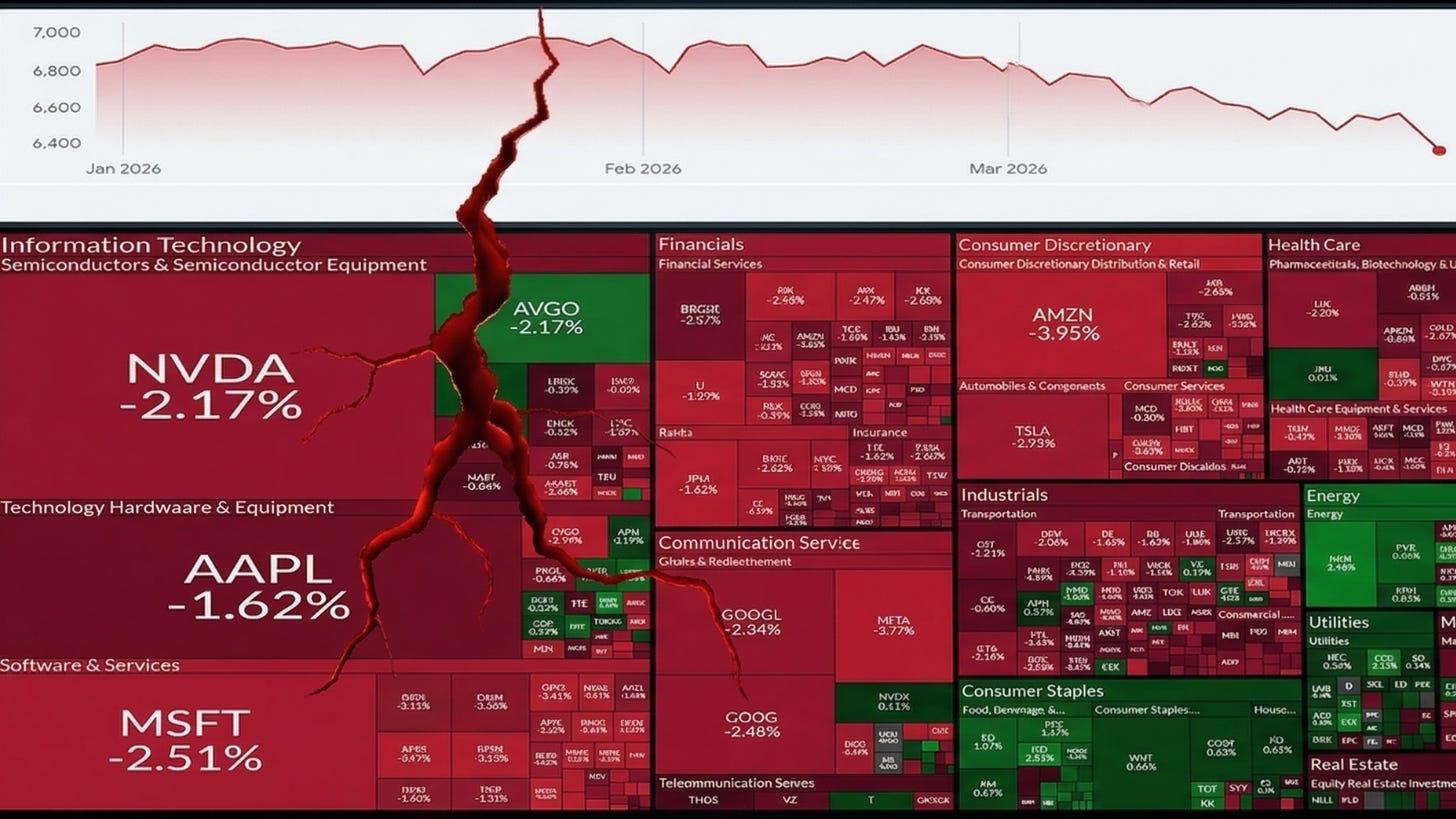
I have no idea if what we have seen so far in 2026 is a prelude to a big stock market crash or not. Neither do you. Here is what I do know:
Market crashes have happened and will happen
We entered 2026 with high stock valuations
Speculation has been pretty rampant over the last few years and we haven’t seen a real downturn/market decline since 2008-2009
We are starting to see cracks in the credit markets
Geopolitical shocks of war and inflation are interacting with an economy that is already more fragile than normal
So whether we are in an early phase of a big market crash or not, you should be prepared. Here are 7 things NOT to do during a stock market crash:
1. Don’t Buy Too Early
Benjamin Graham famously piled into the markets way too early during the 1929 crash, and lost his partners a lot of money. Stocks have been expensive lately. Just because a stock is down from $100 to $75 does not mean it’s now a deep bargain.
Have you considered that perhaps it was never worth $100 to begin with, but rather $75? Or worse yet $50?
Don’t use yesterday’s market prices as an anchor of value - they are just what some folks were willing to pay at a moment in time.
2. Don’t Get Paralyzed
I will be honest. When I was a young analyst at Fidelity in 2001-2002, I got paralyzed looking at daily market drops. -2%. -3%. Etc.
I even started thinking about where the market will go, how far we have to go down until the bottom, and so forth. That’s a terrible way to think. Nobody knows where the market will bottom.
Group psychology is impossible to predict. However, you can have an informed opinion on the value of a company. Not every company, but ones within your circle of competence.
So when companies you know well and have thoroughly appraised are trading at a deep discount, don’t avoid acting out of fear about the markets.
3. Don’t Panic Sell
Chances are you aren’t used to watching the prices of your stocks falling. The last 15 years had very few periods when they did, and those were very short by historical norms. Yes, we saw a big drop due to COVID in 2020, but it lasted what, a few months? Then the government pumped a ton of liquidity into the system and markets soared.
All this financial media talk of ‘dip buyers’ might have trained you that any decline is going to be short-lived. That’s not how it always works.
Sometimes stocks go down, and then go down some more. And then they drop again.
When you combine that with macro fears, falling profits and scary headlines, it’s easy to panic. Don’t. Stick to your investment process and don’t sell because of emotions.
4. Don’t Buy Cheap Trash
After several years with bargains scarce, it’s easy to get tempted by the first legitimately cheap stock you come across. Just like a sailor stumbling on shore after a long voyage, everything might look attractive.
However, downturns aren’t just other people’s paper losses. They cause real stresses on industries and companies.
Not every company will have the quality or the balance sheet to prosper or even survive. Remember, the downside of any stock, no matter how cheap, is still 100%.
As Charlie Munger framed it, always invert. What’s the best way to lose money? It’s to:
Buy bad businesses
Run by incompetent or dishonest people
With fragile balance sheets
At high prices
Now invert - use this as a mini-checklist of characteristics to avoid, no matter how cheap the stock superficially looks.
5. Don’t Invest Without a Written Investment Process
You should always have your investment process written down. It’s a great way to keep yourself disciplined to what you, at your best, have decided is the right way for you to invest.
There is no time when that is more important than when markets are falling and emotions are running high. Make sure your written process is a) ready b) current c) something you fully believe in. Then stick to it.
6. Don’t Invest Based on the News
You and I don’t know what will happen in Iran. If oil prices will go to $200 or $60. Or if inflation will spike or not.
The media is paid to generate daily headlines to grab your attention and sell you ads. That’s fine, that’s their business model. Don’t use that as a serious input into your investing process. They don’t know any more than you do.
7. Don’t Borrow Someone Else’s Conviction
It can be tempting to listen to some experienced investor recommend a stock. Or watch a fund manager buy it and follow them. Don’t do this without doing your own work.
It’s one thing to get the idea from someone else and then to rigorously put it through your process to make it your own. By the way, you will probably reject many of these along the way. It’s quite another to blindly listen to someone else.
Bad idea. They can be wrong. They can be right but you might not have their conviction when the going gets tough and sell at the bottom. Or there could be an even better idea for you that they don’t know about or can’t take advantage of.
Serious investors do their own research.
Conclusion
Here is the thing: odds are you haven’t been through a real market crash. I started my professional investing career mid-2001, so I have now invested through two. You can read about them all you want, but it sure is different when it’s actually happening and you have to invest through one.
Preparing won’t lead to you making perfect decisions. However, it can help you accomplish 3 things:
Avoiding large permanent losses
Taking advantage of incredible investing opportunities
Acting at your own pace, not one dictated by the frenetic activity of the markets and the news media
Stay rational. Focus on 5-10 years out, not on 5-10 weeks out. Stick to your process and execute.
What would be #8 for you on this list? Please leave a comment below, I read and respond to every one. And if this article helped clarify your thinking, please restack it to help others.
Disclaimer: Not financial advice, for educational purposes only.
About the author

Gary Mishuris, CFA is the Managing Partner and Chief Investment Officer of Silver Ring Value Partners, an investment firm that seeks to apply its intrinsic value approach to safely compound capital over the long-term. He also teaches the Value Investing Seminar at the F.W. Olin Graduate School of Business.
I find that my biggest psychological issue with downturns is deploying capital. I don’t think people panic sell unless pressured (we hate realized losses)- or unless markets have been down for so long, people give up- I haven’t lived this so far. so the biggest conundrum is to have an emotional capital deployment freeze- not selling losers but also not buying because it’s scary out there. I like to keep a watchlist of good stuff that I’d like to buy at a discount (or top at a discount- many of my holdings trade cheaply).
Good basic common sense advice. It’s meant as a compliment. Good sound advice, in today world, is not to be taken for granted or underestimated. Many of today’s “new” investors would benefit from your simple advice. I hope they take notice. Thank you for sharing.