



(Note: If you are just joining the seminar, please start by reading the Introduction)
Note: This assignment is due in 2 weeks, with your responses due by the evening of Thursday, November 19th. The next assignment should be posted on Friday, November 20th.
When I was just starting out as an investor, 25 years ago, I used to think that if a stock traded below book value it was probably a bargain. How things have changed.
The reality is that even back in Benjamin Graham’s days, a stock trading below book value was an invitation to do further work, not a sure-fire sign of an undervalued security. After all, remember that book value is just the historical amount of equity capital that went into the business. It tells you little about what that business is now worth under its current competitive reality.
Investors who have only come across Graham’s work superficially typically know him for his “net-nets.” Hopefully if you have read Parts 1 through 5 and answered the questions in this seminar, you know by now that there is a lot more to Graham than that.
However, even Graham’s “net-nets” are frequently misunderstood. People want to make them into a mechanical, formulaic calculation that is black and white. That is not the case. Reality is more complicated than that.
When you look at Graham’s suggested table for calculating liquidation value below, did you understand a) why these balance sheet items need a discount b) why the discount is increasing as you go down the table and c) why the range is getting wider?
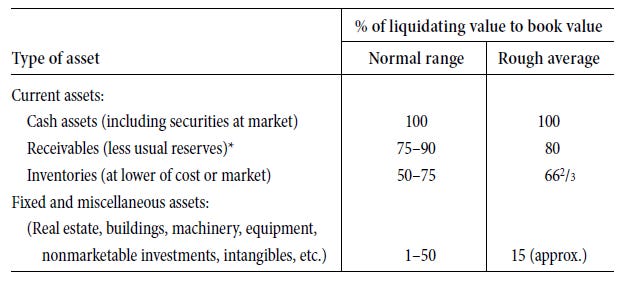
Source: Security Analysis, Benjamin Graham, 6th Ed, Pg. 560
Pause for a minute and try to answer those questions.
If you had trouble, consider different business types that might be undergoing a liquidation. For example, what would demand a bigger haircut: the inventory of a teenage apparel retailer that ran into trouble, or a seller of gold coins?
Or if you are considering the discount applicable to Property, Plant & Equipment, think about whether a greater discount would need to be applied to PP&E that has many alternative uses as opposed to highly specialized equipment?
Even though this is what Graham is most known for, and most investors treat this as a purely quantitative calculation, I hope that by now you appreciate how much qualitative judgement is still involved. Never let formulas replace a fundamental understanding of the business, whether you are following Graham’s approach or a completely different one.
Those who have only vaguely heard about Graham rarely understand his approach. They might think all he did was net-nets or have known him only for the “Mr. Market” analogy.
By now, having read all of Security Analysis, you know there is much more to Graham than that.
Graham was a product of his time and experience. Having lived through, and lost money in, the Great Depression, he formulated a careful investing methodology centered around guarding against losses. To him, thorough study of the past was a prerequisite for forming a view of the future. The latter was something to be guarded against, not profited from.
While Graham’s primary approach was quantitative fundamental analysis, he acknowledged the importance of qualitative factors. However, he did not go into much depth on qualitative analysis, so in order to learn how to actually do it we will need to rely on other investing masters.
The overarching summary of Graham’s approach is reversion to the mean. He wanted to buy securities at prices low enough that even if the future were somewhat worse than the past, he would still do OK. He was also a broadly diversified investor, which was consistent with the medium depth of his research and the need for large numbers in order to capture the expected return.
In response to Question 1 Lattice Notes wrote:
Book value can be a useful starting point to understand the net assets attributable to shareholders. Some of the useful features can be to evaluate return on equity and with the balance sheet can help us understand the financial strength of the company, including debt and liability. Its limitations are that it is an accounting value, not the economic or intrinsic value of the business. It may not reflect the actual value of the assets, nor does it tell us how profitable the assets will be.
In response to Question 2 Chris Carothers wrote:
Graham believed book value had practical use not in relation to market price rather than “sensible satisfaction”. (pg 558).
Graham noted that book value is highly practical for analyzing financial institutions (like banks and insurance companies), utilities, and transportation companies.
I believe that portions of the balance sheet can easily be manipulated to fit the accounting needs of the business, mostly by manipulating intangibles like Goodwill.
For example, unlike tangible assets (like buildings or inventory), goodwill represents intangible value—such as brand reputation, customer loyalty, and intellectual property. Companies can use these liberally, (example: acquiring it during a business buyout). Because it cannot be bought or sold independently, its true value is difficult to measure, making it susceptible to distortion.
In response to Question 3 Tibor V wrote:
According to Graham “Liabilities are real and Assets must be questioned”
Graham gives the following normal ranges (NR) and rough averages (RA) for estimating liquidation value to book values:
- Cash assets: NR at 100%, RA at 100%
- Receivables: NR at 75%-90%, RA at 80%
- Inventories: NR at 50%-75%, RA at 66%
- Fixed and miscellaneous assets: NR at 100%, RA at 15%
- Liabilities taken at 100%.
These averages should be applied by line items in the balance sheet and divided by the average number of shares to arrive to a liquidation value per share.
In response to Question 8 Tony wrote:
Studying comparable companies in the same field can be valuable in identifying undervaluation and overvaluation. This is most useful in companies that are more homogenous, similar products and business models. It is less useful in heterogeneous companies, different products (especially branded) and different geographies. Qualitative factors like management must also be taken into account or one may mistake businesses as homogenous and comparable.
Week 5 assignment is to read Philip Fisher’s Common Stocks and Uncommon Profits.
Question 1: What are the similarities between Fisher’s investing philosophy and Graham’s? What are the differences?
Question 2: What aspects of each, if any, would you like to make part of your own approach?
Question 3: How would Fisher define the margin of safety for an investment? How does that compare with how you think Graham would define it?
Question 4: How does Fisher approach valuation? What do you think about his approach?
Question 5: What do you think about Fisher’s checklist for assessing a company? Are there items you would add? Remove?
Question 6: What are the 3 most important criteria from Fisher’s list and why?
Question 7: If you were trying to generate potential candidates for the type of companies that Fisher is looking for, how would you go about it?
Question 8: Find 3 potential investment candidates that you think currently fit Fisher’s criteria and explain why they do so. Please go in some depth in your analysis/explanations for why they are a potential fit using Fisher’s criteria.
Question 9: What are the weaknesses of Fisher’s approach?
Question 10: Map Fisher on as many dimensions of an investment style as you can (use this article for reference on the dimensions.)
Question 11: Come up with an AI prompt based on Phil Fisher’s approach.
Now it’s your turn:
Submit your answers in the comments below this article with all your answers in a single comment. I will engage with some of the answers each week and highlight some of the ones I find most insightful in next week’s seminar assignment article. Please submit your answers by the evening of Thursday, November 19th.
Engage with the answers of some of your fellow seminar members in the comments below. Remember – the goal is to learn together. Be kind, be respectful and try to add to our learning as a community.
Feel free to ask any questions about the reading in your comment.
Until two weeks from now,
Gary
About the author

Gary Mishuris, CFA is the Managing Partner and Chief Investment Officer of Silver Ring Value Partners, an investment firm that seeks to apply its intrinsic value approach to safely compound capital over the long-term. He also teaches the Value Investing Seminar at the F.W. Olin Graduate School of Business.