



Welcome to the seminar. Before we dive in, a few logistical items:
If you haven’t yet, please introduce yourself in the introduction thread
I posted a Reading List post which I will update ahead of when you need to get each book/resource. Keep an eye on it and order these in advance so that they don’t become a bottleneck
It’s not too late: please share this post with friends or colleagues who you think would enjoy joining us. More serious, engaged students = better learning environment for everyone. Plus, you are less likely to quit if you have a buddy doing this with you
Please don’t take engaging with other people’s answers in the comments section as optional. It will enhance both your learning and everyone else’s
I am going to make a small change, and rather than automatically send out one assignment per week, I will have some assignments span 2 weeks. The reason is to combine rigor with a reasonable amount of time for busy folks like you to finish the assignments. The default is still one week, so unless I say otherwise everything should be done by early Friday morning the following week
As I wrote in the introduction, we are going to study the investing greats and put their styles and investment processes through our understand, apply, and customize framework. The goal is to help you develop the best investing style and process for you.
Before we begin with this week’s reading, let’s dive a bit deeper into what makes an investing style. As you study the masters, it would be helpful if you could do more than just say, “Gee, I like how he does that,” and get more specific about what you might want to incorporate into your own approach and what you would rather leave out. The framework I like to use for this is dimensions of an investing style.
Think of a dimension of a style the way you would think of an x- or y-axis in geometry. Each dimension is independent of the others. There are many dimensions, and far more possible investing styles based on the various combinations of “values” along each dimension.
There are many valid ways to combine how a style is positioned on each dimension. However, not every combination is equally rational. Let me explain with an example.
Let’s take two dimensions, Diversification and Depth of Research. Of course, dimensions have a continuum of values, but for the sake of simplicity let’s assume that each of these can take one of two values:
Diversification: Very Diversified or Highly Concentrated
Depth of Research: Shallow or Deep
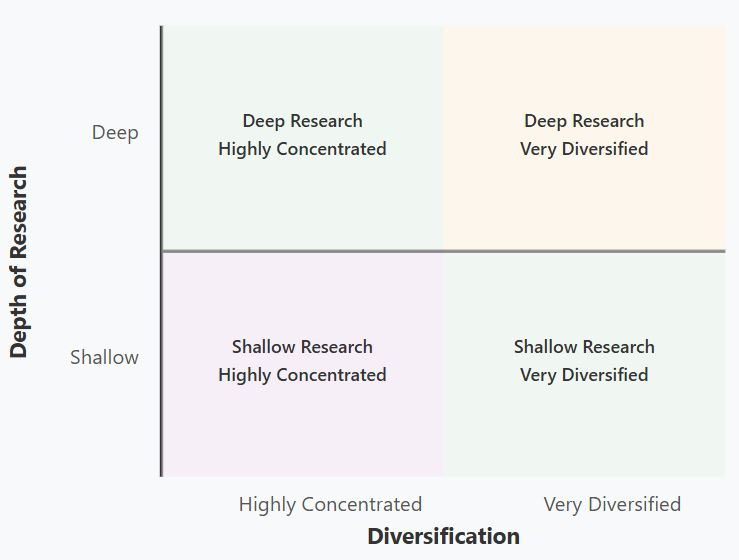
Let’s think through each of the four combinations:
Deep Research, Highly Concentrated: Makes perfect sense — if you are going to concentrate, you better know your investments well.
Shallow Research, Very Diversified: Also very rational — if you know each investment just superficially (e.g. a valuation statistic only), you best diversify broadly.
Deep Research, Very Diversified: On the surface this might not make sense, but it could. For example, imagine a large firm with an army of analysts. Each analyst could have a lot of depth on a small number of investments and the portfolio manager could construct a diversified portfolio out of their ideas.
Shallow Research, Highly Concentrated: This one makes no sense and would be a recipe for investing disaster.
The point is that while there are many valid ways to combine positioning along the different dimensions, there are also invalid combinations. Many things go, but not everything does.
Question 0: Come up with as many other dimensions of an investing style as you can and provide a scale for each of those dimensions (e.g. Diversification [high to low]). Hint: The highest number of dimensions that I’ve received over the years in response to this question was 20+, so don’t give up too soon.
Now let’s move on to our reading for this week: Benjamin Graham’s Security Analysis, Part 1. Before we get to the questions, a few words about why I am starting our journey here. After all, several professional investor friends have disagreed with this choice.
Here is the thing: investing is hard, and it takes hard work to become good at it. Many will not want to put in the effort to study Security Analysis. I understand. It’s not beach reading, that’s for sure.
It would be much easier to start with, say, Graham’s Intelligent Investor, easily digest the concepts and feel good about ourselves. That would, however, deprive the serious student of the real opportunity to learn, and that’s who the seminar is designed to benefit the most. After all, Graham intended The Intelligent Investor for the casual audience and Security Analysis for the serious professional.
You might be thinking, “But isn’t Security Analysis outdated? Does it still apply when so much about the investing world has changed since Graham wrote it? Aren’t there whole industries that weren’t around back then, new types of businesses and technology, and so on?”
And as I write this in the fall of 2026, years into a momentum-driven bull market, some of you are probably wondering if “classical” value investing is still relevant at all.
I don’t blame you. Yes, things are different. We will discuss those differences since it’s core to how we would want to apply Graham’s ideas today. Some of you might decide that much, or all of Graham’s approach doesn’t fit how you want to invest. That’s fine. First, let’s understand it, master the fundamentals, and then customize in a way best for each one of us in the current era.
Question 1: When did Graham write the first edition of Security Analysis and how did the environment during which he was operating and writing influence his work?
Question 2: What’s Graham’s investment philosophy? Why does he think that’s best?
Question 3: Which parts of his approach do you think you want to imitate? Which ones do you think you would rather not? Why? (we will revisit this at the end of the book)
Question 4: What’s the difference between an investment and a speculation? Why did Graham choose the words that he did to define it, and what are the implications of his choices for investing?
Now it’s your turn:
Submit your answers in the comments below this article with all your answers in a single comment. I will engage with some of the answers each week and highlight some of the ones I find most insightful in next week’s seminar assignment article.
Engage with the answers of some of your fellow seminar members in the comments below. Remember: the goal is to learn together. Be kind, be respectful and try to add to our learning as a community.
Feel free to ask any questions about the reading in your comment.
Until next week,
Gary
About the author

Gary Mishuris, CFA is the Managing Partner and Chief Investment Officer of Silver Ring Value Partners, an investment firm that seeks to apply its intrinsic value approach to safely compound capital over the long-term. He also teaches the Value Investing Seminar at the F.W. Olin Graduate School of Business.