



(Note: If you are just joining the seminar, please start by reading the Introduction)
One important lesson from Part 2 is that the investment approach needs to be heavily influenced by the distribution of returns of the securities in which one is investing. Consider the two extremes: high-grade bonds vs. venture capital.
The distribution of returns among high-grade bonds is as follows: out of 100 bonds you are likely to have a couple that will default and the rest will pay as promised. The ones that default, even with some recoveries, will result in a very large, 50%+ loss. The difference among the ones that don’t default will be very small, usually a percent or so in yield per year.
Your success will not depend on choosing among the bonds that don’t default but rather on eliminating the few that will. In other words, there is almost no penalty for incorrectly eliminating a security that you even remotely suspect could default.
Compare that with venture capital. Here you are likely to have a couple of huge winners with returns of 100x+, some far smaller winners and many large losers. Here, it doesn’t matter how many complete losses you avoid if you don’t catch the one or two 100x returning start-ups. The cost of a mistake of omission, unlike in high-grade bonds, can be huge.
Another lesson that Graham teaches us in Part 2 is that it is better to avoid trouble than to rely on assets to protect us. His concept is to focus on a company’s ability to pay rather than on the collateral supporting a bond. There are several reasons for this, including the time it would take to get your money back in bankruptcy, the frictional costs involved and the uncertainty of the market value of collateral when it needs to be liquidated.
Graham gives us several formulas/criteria to use as a checklist for a high-grade bond. This is probably the part that needs to be updated for modern times and analytical tools. Here is a brief overview of what is used in modern times:
Coverage Ratio
The benefit of the coverage ratio is that it measures ability to pay directly. The numerator should be a measure of pre-tax cashflow available to pay mandatory fixed charges and the denominator should be the fixed charges. The denominator is mostly interest expense, although it can include other items such as mandatory pension contributions or mandatory legal payments.
The numerator is where I think we need to update our approach from Graham’s. Graham used EBIT (Earnings before Interest and Taxes), but that’s too punitive. EBIT subtracts both depreciation and amortization. Most amortization is a non-cash accounting charge (more on this in a later reading). Depreciation is quite real, but here we need to think about the timing of payments.
When looking at interest coverage, we care about the following scenario: the company is in distress, its profitability is depressed and it needs to figure out if it can find enough cashflow to meet its interest payments until its business recovers. Depreciation has a corresponding cash outlay – Capital Expenditures. However, CapEx can be broken up into 2 components: growth and maintenance.
The maintenance CapEx component can mean different things depending on the question being asked. From the point of view of the equity investor, long-term maintenance CapEx is rarely below depreciation. That’s the reason for using Graham’s EBIT approach. However, when the company is in temporary distress and is just trying to make it through to the other side of whatever challenges it is facing, that’s not the relevant maintenance CapEx because much of it can be deferred. So, there is a lower, ‘bare-bones’ maintenance CapEx that is the right number to think about for the purposes of credit analysis.
The complete formula for the coverage ratio would be: (EBITDA – bare-bones maintenance CapEx) / (All Mandatory Fixed Charges). In practice, what we see in modern bank covenants is a simplified ratio of EBITDA/Interest. While it ignores some nuances, it is approximately right, especially if the threshold level is set higher than an EBIT/Interest ratio would be set to account for the numerator being an overestimate of the available cash flow.
Leverage Ratio
While Graham referred to Equity/Debt as the leverage ratio, there is another leverage ratio that is commonly used in credit analysis. While the coverage ratio measures ability to pay directly, its shortcoming is that it is relying on current interest rates.
For example, consider a company that has variable interest rate debt. It might have a coverage of 4x in a low-rate environment, but if interest rates were to spike that ratio would deteriorate substantially. The alternative is the leverage ratio defined as: Debt/EBITDA, which is one of the two ratios commonly seen in modern bank covenants. For context, a BBB-rated industrial company usually has Debt/EBITDA below 3.5x.
As a thought exercise, can you calculate the relationship between the coverage ratio (EBITDA/Interest) and the leverage ratio (Debt/EBITDA) at different levels of debt and different interest rates?
Regarding Question 1 Navin wrote: “Graham writes that “Bond investing is a commitment with limited return”. The chief emphasis on avoidance of loss reflects the reality that any failure by the issuer to meet obligations can result in total loss, making safety the primary concern. The investor may reject bonds with no penalty because passing on a bond does not mean missing out on extraordinary gains, allowing for strict selectivity without regret. Graham uses these phrases to highlight the fundamentally defensive nature of bond analysis, where the art lies in eliminating risk rather than forecasting reward.”
Regarding Question 3 James wrote: “Preferred stock, because the security does not stop poor performance in hard times, and limits the upside in good. Either way it’s a poor proposition, of the “heads I win, tails you lose” sort.”
Regarding Question 5, the biggest thing that I would do differently from most of your answers is ask a lot more qualitative questions. For example, wouldn’t it make a huge difference if the historical profitability of the taxi driver was achieved with a ride-sharing company already operating in the town vs. one just having announced that it is about to enter the market? Also, applying the ideas above, the Coverage Ratio would be 6x (EBIT = $10, Depreciation = $20, EBITDA = $30, Interest = $5). It’s certainly not wrong to use Graham’s stricter standards of EBIT/Interest which would as most of you pointed out be only 2x.
Regarding Question 7 where I asked you to come up with an AI prompt based on Part 2 of Security Analysis, one idea I had was to use a “meta” prompt for idea generation. I created a very simple prompt, as follows:
“Act as an expert on Benjamin Graham and on Security Analysis. Generate 5 prompts based on ideas in Part 2 of Security Analysis that would be useful to a long-term investor. Output: at the top summarize the goal of each of the 5 prompts, then provide the detailed prompts below. reasoning_effort=high.”
Here are the ideas that ChatGPT 5 came up with:
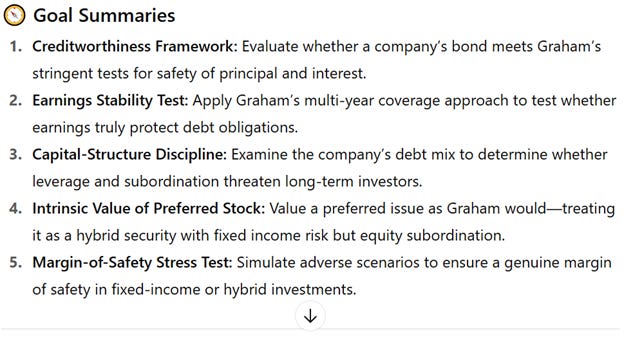
And here is what Claude Sonnet 4.5 came up with:
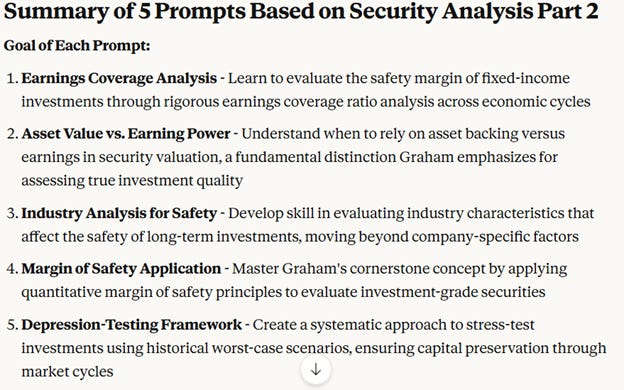
The point isn’t to fully rely on AI to do your thinking for you, but rather to brainstorm to see what you haven’t thought of and to supplement your own thinking.
Week 3 assignment is to read Part 3 of Security Analysis and answer the following questions:
Question 1: Why does Graham believe that Senior Securities with Speculative Features are typically attractive in form? Do you agree?
Question 2: Graham states that the record of such securities has been unenviable. Why? See if you can do some research about whether that statement has been true in recent times - e.g. the last 20-30 years.
Question 3: What are Graham’s views on the importance of the terms of the speculative features in such securities vs. the prospects of the underlying enterprise? What do you think about this balance?
Question 4: Find a current security that Graham would classify as a Senior Security with Speculative Features. Would Graham consider it attractive at the current price? Why? Do you? Why?
Question 5: Where does Graham place speculative fixed income securities (high-yield bonds/junk bonds) on the continuum between stocks and high-grade bonds? Would his classification be the same in the current market, and if not how would it differ? How does Graham suggest approaching investing in such securities?
Question 6: Are the inefficiencies that Graham refers to for all of these security types still the same today. Why/why not? If not, which ones have become more vs. less efficient?
Question 7: Find a high-yield security and analyze it using Graham’s approach. Would he consider it attractive? Do you?
Question 8: Create an AI prompt based on the material covered by Graham in Part 3 that would aid you in your investing.
Now it’s your turn:
Submit your answers in the comments below this article with all your answers in a single comment. I will engage with some of the answers each week and highlight some of the ones I find most insightful in next week’s seminar assignment article.
Engage with the answers of some of your fellow seminar members in the comments below. Remember – the goal is to learn together. Be kind, be respectful and try to add to our learning as a community.
Feel free to ask any questions about the reading in your comment.
Until next week,
Gary
About the author

Gary Mishuris, CFA is the Managing Partner and Chief Investment Officer of Silver Ring Value Partners, an investment firm that seeks to apply its intrinsic value approach to safely compound capital over the long-term. He also teaches the Value Investing Seminar at the F.W. Olin Graduate School of Business.
Are you enjoying the Seminar? You can help spread the word and grow our community by resharing my LinkedIn post about this week's seminar. The more like-minded investors like us we have join, the richer the discussion will be.
The post is here: https://www.linkedin.com/posts/gary-mishuris_education-investing-learning-activity-7384930846383767552-wHHq
Question 1:
Why does Graham believe that Senior Securities with Speculative Features are typically attractive in form? Do you agree?
Benjamin Graham addresses this directly:
“Such issues must therefore be considered as the most attractive of all in point of form, since they permit the combination of maximum safety with the chance of unlimited appreciation in value. A bond that meets all the requirements of a sound investment and in addition possesses an interesting conversion privilege would undoubtedly constitute a highly desirable purchase. “
My opinion:
This is true, but as with all securities the underlying performance of the company drives the results. A good stock would see the common perform better, a poor one, losses on the bond if it became insolvent. The results are all strongly correlated to the underlying performance.
Question 2:
Graham states that the record of such securities has been unenviable. Why? See if you can do some research about whether that statement has been true in recent times - e.g. the last 20-30 years.
He shows a table of securities and their performance, and in general they were poor with hindsight. The bonds were issued by weaker companies in order to entice reluctant investors attracted by the form, and their weakness gave poor results. The good form of an investment generally does not make up for lack of quality.
In recent times investment has been better than then.
“From 1988 through 2021, the ICE BofA U.S. Convertible Index captured about 80% of the upside and 60% of the downside of the average rolling 12-month returns of the S&P 500, NASDAQ Composite, and Russell 2000 indices.”
This is a nice indicator of their attractive form. The investor gives up a proportion of their profits for a greater preservation of capital in tough times.
Question 3:
What are Graham’s views on the importance of the terms of the speculative features in such securities vs. the prospects of the underlying enterprise? What do you think about this balance?
He thought that the terms had to suit the investors view of the underlying strength of the enterprise. He says “Generally speaking, there should be no middle ground. The investor interested in safety of principal should not abate his requirements in return for a conversion privilege; the speculator should not be attracted to an enterprise of mediocre promise because of the pseudo-security provided by the bond contract.” The terms can be unfavourable and unlikely to lead to a satisfactory profit even if the underlying security is strong, and favourable terms can still lead to poor returns if the underlying securities are weak as happened in his time.
I think that while the terms are the primary driver of the rationale for the investment, the likely performance and strength of the company have to be assessed in the light of those terms.
Question 4:
Find a current security that Graham would classify as a Senior Security with Speculative Features. Would Graham consider it attractive at the current price? Why? Do you? Why?
WisdomTree 4.625% Convertible Senior Notes due 15-Aug-2030
Evaluation as a bond according to Graham using ChatGPT prompt:
Rank Test Ratio Difference from Minimum Certainty Pass/Fail
1 Size – sales ≥ US$0.5 bn ~US$427.7 m (2024) 0.4277 – 0.500 = -0.0723 bn High Fail
2 Normalised pretax profits / interest cost ≥ 4× Pretax (~US$95.4 m) / Interest expense (~US$18.9 m) = ~5.05× 5.05 – 4 = +1.05× High Pass
3 Poorest year profits / interest cost ≥ 3× (Poorest visible year: 2022 pretax ~US$39.95 m) ÷ Interest cost (assume similar ~US$15 m) → ~2.6× 2.6 – 3 = -0.4× Medium Fail
4 Total borrowing / normalised pretax profits < 5× Debt ~US$512 m ÷ Pretax ~US$95.4 m = ~5.37× 5.37 – 5 = +0.37× (worse) High Fail
5 Working capital > total borrowing Current assets minus current liabilities not clearly > debt (data incomplete) Unknown Medium Fail (data gap)
6 Equity value ≥ 75% of total borrowing Equity ~US$~374.9 m as of Sept-24 vs debt US$512 m → ~73%
ChatGPT flubs Question 5 (financial company accounts are different from industrials) but it would also fail. Current assets $318m. Borrowing $633.6m.
By modern standards I think this looks okay, but rating around BB+. 80 basis points premium.
Valuation as an option
Exercisable price $19. Current price $12.56. Various caps make the total upside limited as the company can redeem early if it rises above 130%. Strategy. Wait until it reaches $25 and sell. Gives a 30% capital uplift. In line with Graham’s recommendation.
Underlying performance of the stock is stable to improving.
Would Graham or I think pass it? There are plenty of risks here. I think Graham would fail this on margin of safety grounds. I think on balance it would be worth a small bet. Unfortunately it can only be bought by professional US investors so it will remain theoretical for me.