



Welcome to the seminar. As I wrote in the introduction, we are going to study the investing greats and put their styles and investment processes through our understand, apply, and customize framework. The goal is to help you develop the best investing style and process for you.
Before we begin with this week’s reading, let’s dive a bit deeper into what makes an investing style. As you study the masters, it would be helpful if you could do more than just say, “Gee, I like how he does that,” and get more specific about what you might want to incorporate into your own approach and what you would rather leave out. The framework I like to use for this is dimensions of an investing style.
Think of a dimension of a style the way you would think of an x- or y-axis in geometry. Each dimension is independent of the others. There are many dimensions, and far more possible investing styles based on the various combinations of “values” along each dimension.
There are many valid ways to combine how a style is positioned on each dimension. However, not every combination is equally rational. Let me explain with an example.
Let’s take two dimensions, Diversification and Depth of Research. Of course, dimensions have a continuum of values, but for the sake of simplicity let’s assume that each of these can take one of two values:
Diversification: Very Diversified or Highly Concentrated
Depth of Research: Shallow or Deep
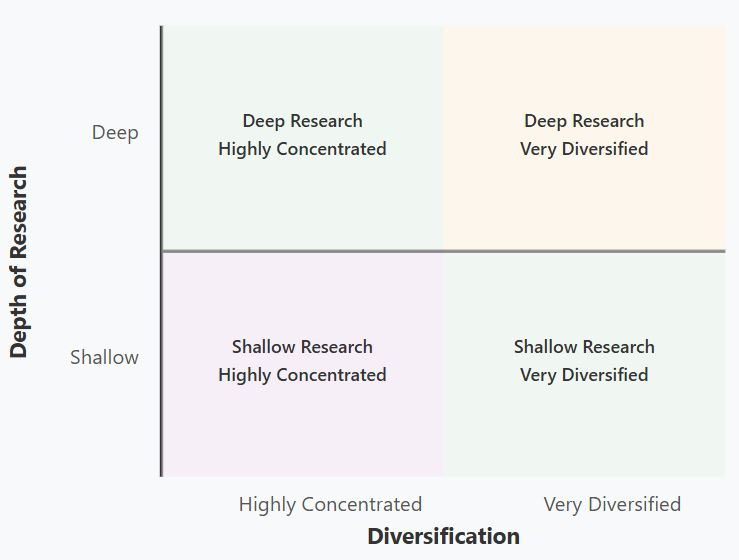
Let’s think through each of the four combinations:
Deep Research, Highly Concentrated: Makes perfect sense — if you are going to concentrate, you better know your investments well.
Shallow Research, Very Diversified: Also very rational — if you know each investment just superficially (e.g. a valuation statistic only), you best diversify broadly.
Deep Research, Very Diversified: On the surface this might not make sense, but it could. For example, imagine a large firm with an army of analysts. Each analyst could have a lot of depth on a small number of investments and the portfolio manager could construct a diversified portfolio out of their ideas.
Shallow Research, Highly Concentrated: This one makes no sense and would be a recipe for investing disaster.
The point is that while there are many valid ways to combine positioning along the different dimensions, there are also invalid combinations. Many things go, but not everything does.
Question 0: Come up with as many other dimensions of an investing style as you can and provide a scale for each of those dimensions (e.g. Diversification [high to low]). Hint: The highest number of dimensions that I’ve received over the years in response to this question was 20+, so don’t give up too soon.
Now let’s move on to our reading for this week: Benjamin Graham’s Security Analysis, Part 1. Before we get to the questions, a few words about why I am starting our journey here. After all, several professional investor friends have disagreed with this choice.
Here is the thing: investing is hard, and it takes hard work to become good at it. Many will not want to put in the effort to study Security Analysis. I understand. It’s not beach reading, that’s for sure.
It would be much easier to start with, say, Graham’s Intelligent Investor, easily digest the concepts and feel good about ourselves. That would, however, deprive the serious student of the real opportunity to learn, and that’s who the seminar is designed to benefit the most. After all, Graham intended The Intelligent Investor for the casual audience and Security Analysis for the serious professional.
You might be thinking, “But isn’t Security Analysis outdated? Does it still apply when so much about the investing world has changed since Graham wrote it? Aren’t there whole industries that weren’t around back then, new types of businesses and technology, and so on?”
And as I write this in the fall of 2025, years into a momentum-driven bull market, some of you are probably wondering if “classical” value investing is still relevant at all.
I don’t blame you. Yes, things are different. We will discuss those differences since it’s core to how we would want to apply Graham’s ideas today. Some of you might decide that much, or all of Graham’s approach doesn’t fit how you want to invest. That’s fine. First, let’s understand it, master the fundamentals, and then customize in a way best for each one of us in the current era.
Question 1: When did Graham write the first edition of Security Analysis and how did the environment during which he was operating and writing influence his work?
Question 2: What’s Graham’s investment philosophy? Why does he think that’s best?
Question 3: Which parts of his approach do you think you want to imitate? Which ones do you think you would rather not? Why? (we will revisit this at the end of the book)
Question 4: What’s the difference between an investment and a speculation? Why did Graham choose the words that he did to define it, and what are the implications of his choices for investing?
Now it’s your turn:
Submit your answers in the comments below this article with all your answers in a single comment. I will engage with some of the answers each week and highlight some of the ones I find most insightful in next week’s seminar assignment article.
Engage with the answers of some of your fellow seminar members in the comments below. Remember – the goal is to learn together. Be kind, be respectful and try to add to our learning as a community.
Feel free to ask any questions about the reading in your comment.
Until next week,
Gary
About the author

Gary Mishuris, CFA is the Managing Partner and Chief Investment Officer of Silver Ring Value Partners, an investment firm that seeks to apply its intrinsic value approach to safely compound capital over the long-term. He also teaches the Value Investing Seminar at the F.W. Olin Graduate School of Business.
Thank you for running this course, I like to have my thinking challenged, and the first question did just that. Here is my list. It made me consider how useful, objective and valid each investment approach is, and which go together well, or not so well, with others.
Dimension Measurement
Diversification Correlation Matrix
Research Research Depth
Volatility VIX, Standard deviation
Quality Custom list of metrics
Momentum % Change in price
Arbitrage Price difference
Special situations value gap, risk
Risk management Sharp Ratio/VaR
Chart shape, technical analysis custom chart formations
Scuttlebutt – networking Non-public information
Activity custom measurement
Growth historical and projected growth
Size Market Cap
Sector Sector exposure %
Value NAV, PE
Income Dividend yield
Time Horizon Average investment time period
Ethics Custom list of metrics
Contrarian % change in price
Volume Trading volume
Skin in the game % Director ownership
Geographical % geographical exposure
A few things that stood out as I looked at the list
Some approaches cluster other approaches strongly:
Short time horizon clusters with Volatility, Momentum, Arbitrage, Volume and technical analysis.
Long time horizon clusters with Research, Quality, Growth, Value, Skin in the game
Others are always important whatever style you use:
Risk Management, diversification
Some are easy to measure and objective, so you can more likely assume they are "in the price":
Size, sector, value, income
Some the whole point is that they are not generally known:
Scuttlebutt information, non listed activities like retailers car park usage, or electricity use by measuring pylon temperature
Some are subjective or estimates, and therefore subject to interpretation and bias:
Quality, Ethics, Contrarian, Research, Special situations, growth
Question 1
it was written in 1934 with Dodds on the basis of his lectures at Colombia from 1928 to 1932 and his experiences in Wall St from 1914 when he graduated. Most people then regarded stocks as gambling, bonds were considered the only safe and respectable investment. Stocks were mostly bought on tips, especially driven by the activity of stock market pools that drove prices both up and down by corners and squeezes. He made his first great win in 1915 by a value play based on the now simple idea that 1 share of Guggenheim Exploration held about 10% more value in listed securities and other assets that it owned.
Question 2
His investment philosophy was of a "margin of safety" using analysis to evaluate the intrinsic value of a share based on it's fundamentals. A long track record of success is necessary and a very high margin of safety for growth projections. The market is not always efficient and this can be used to create value for the patient and disciplined investor.
Question 3
I consider this approach and knowledge necessary but not sufficient. It is always essential to understand accounts, to understand the risks you are taking on fundamentals, and how large they are, and to conduct your own analysis. Much of the information and the approach is timeless: people don't change, and neither do calculations of fundamental value. But some things do change. For example:
The information that Graham had to calculate himself is now generally easily available
The change in technology means that moats and competitive advantage are now both greater and give much larger returns in some cases.
The rise in market multiples make it hard to find good quality candidates with an adequate margin of safety
private equity (who did not exist in those days) frequently buys value plays in smaller companies for relatively modest premiums, resulting in significant losses for mistimed value purchases. Where I live in the UK this is a very common experience.
The greatly increased costs of employing top management talent, of professional advice, and listing of companies, can rapidly erode margins of safety in smaller companies, and significantly dent those in larger ones.
My biggest problem with a pure value approach is the intellectual objection that it always biased towards buying the cheapest companies not the best ones. And cheap does not work. Too often the company is cheap for good reason, and you only find out the reason after you have bought it. Management and sophisticated insiders always know more than you do and accounts are always backwards looking. Value investors often try and fudge this by applying "quality" measures, and other criteria, but this is both subjective, and also a tacit admission of the inadequacy of a wholly value approach.
Question 4
Invest only when there is a significant gap between intrinsic value and market price. Anything else is mere speculation.
Q0: Question 0: Come up with as many other dimensions of an investing style as you can and provide a scale for each of those dimensions (e.g. Diversification [high to low])
I looked at this form the perspective of asset class, which might not be correct, but some other dimensions might be:
Stocks/bonds, options or derivatives/equities, equities/ real estate, equities, commodities/cash, private credit/commercial credit etc this can be somewhat infinite. And From Graham “price and terms” (see below q2)
Other dimensions from Sec Analysis:
Investment : speculation
• Bonds/stocks
• Outright purchases/purchases on margin
• For permanent holdings/for a quick turn
• For income / for profit
• In safe securities / in risky issues
Question 1: When did Graham write the first edition of Security Analysis and how did the environment during which he was operating and writing influence his work?
I am referencing the 7th Edition of Security Analysis and what a wonderful edition it is, with Seth Klarman and a host of masters writing essays as preludes to each part.
1934 was edition 1 in depth of the depression, with many excellent examples of businesses going bust allowing him to hone his principles based on companies that survived.
Question 2: What’s Graham’s investment philosophy? Why does he think that’s best?
I interpret his philosophy as: Know the difference between an investment and a speculation, know thyself and circumstances; are you an untrained individual investor, analyst, money manager or trustee, are you investing your own or others’ money are you buying outright or on margin? Understand time; your time horizon and the impact of time and base your decisions on quantitive and qualitative factors, based of facts. In Grahams words:
“Instead of asking, (1) in what security? And (2) at what price? Let us ask (1) in what enterprise and (2) on what terms” p81 is a simple way of understanding Graham’s philosophy because he establishes clear dimensions for the reader/analyst and sets out 2 principles: “
1. Principle for the untrained security buyer: do not put money in a low-grade enterprise on any terms.
2. Principle for the securities analyst: Nearly every issue might conceivably be cheap in one price range and dear in another” p84.
Why is it the best? Because it allows the analyst to identify “an investment operation”… ”which, upon thorough analysis, promises safety of principle and satisfactory returns” p109 (and this philosophy is applicable irrespective of macro factors).
Question 3: Which parts of his approach do you think you want to imitate? Which ones do you think you would rather not? Why? (we will revisit this at the end of the book)
All of it and especially to better determine investment from speculation and to avoid speculation.
Question 4: What’s the difference between an investment and a speculation? Why did Graham choose the words that he did to define it, and what are the implications of his choices for investing?
“an investment operation is one which, upon thorough analysis, promises safety of principle and satisfactory returns. Operations not meeting these requirements are speculative” p109
The implications are that no one enterprise or issue will always be investment grade and without thorough, ongoing analysis and considering price, the analyst/investor may not realise the investment is actually a speculation instead.