


(Note: this week's case study is 100% free).
If you haven’t read the guide to the 10-Minute Investment Autopsy series, you can find it here. You will get the most out of each case if you:
Pause after the “Original Thesis” section and think about what you would have done
Engage with the discussion questions and other members in the weekly thread designed to help you further improve your investing process
The Original Thesis
Who: Clyde McGregor of Oakmark
When: November 2012
What: Omnicare Inc (ticker: OCR)
The Thesis:
Clyde’s thesis was:
Omnicare is the largest provider of geriatric pharmaceutical services to skilled nursing and assisted living facilities as well as independent living communities.
The company has a dominant market share and is more than 3x the size of the next largest competitor.
The company had poorly run under the prior CEO, but two years ago a new CEO, a former McKesson executive, was brought in who was a significant upgrade. While he has since retired, the current CEO, who was previously the president, is also a straight shooter who is making sensible decisions.
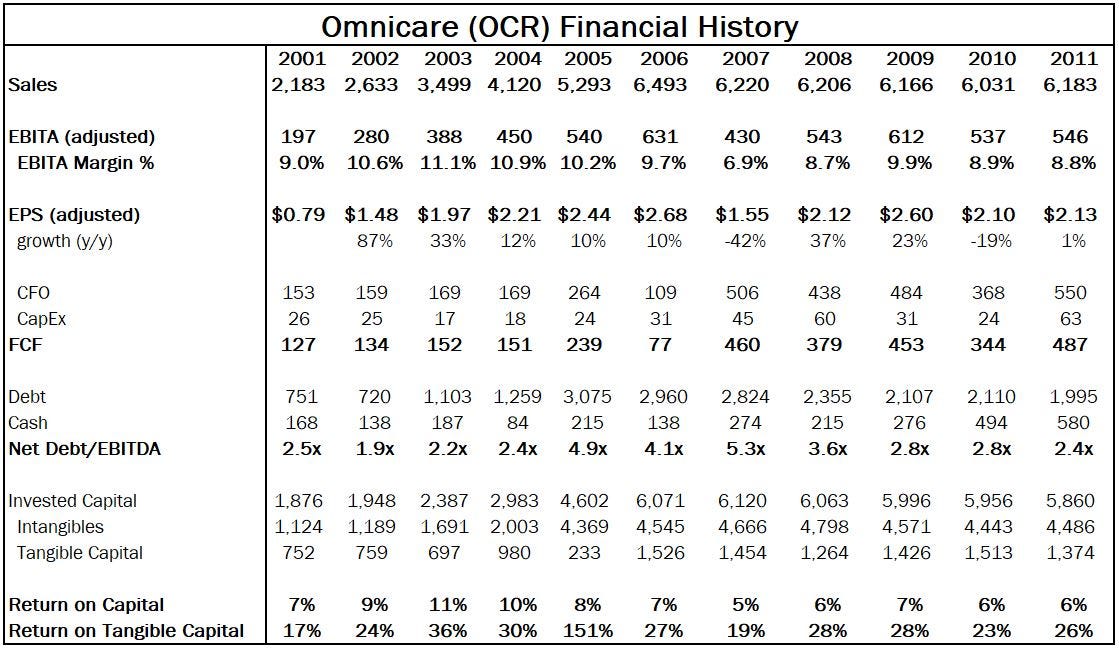
Operating improvements under new management have resulted in higher margins and better client retention, with the latter reaching 93% up from the 80s.
Company is benefiting from secular tailwinds of an aging demographic.
The stock is trading at less than 70% of Clyde’s estimate of intrinsic value and at 11x his 2014 EPS estimate of $3.20 per share.
Earnings are expected to grow at 10%+ per year for the next several years, and at 12x market cap to EBITDA the share price would translate to $60 in 2014, up from the current level of $35.
Healthcare reform is not a risk as end users are either elderly people on Medicare or are prisoners receiving government healthcare.
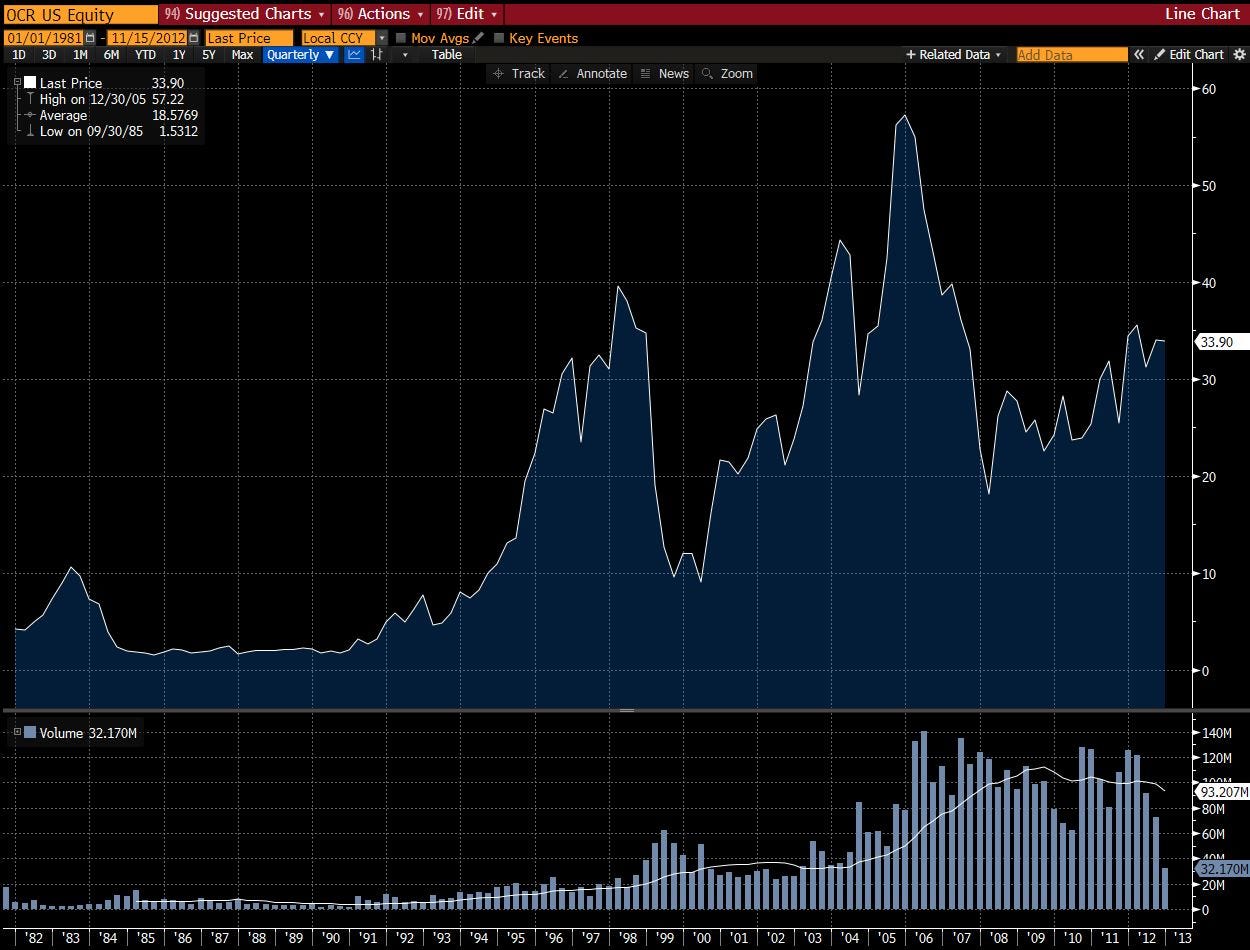
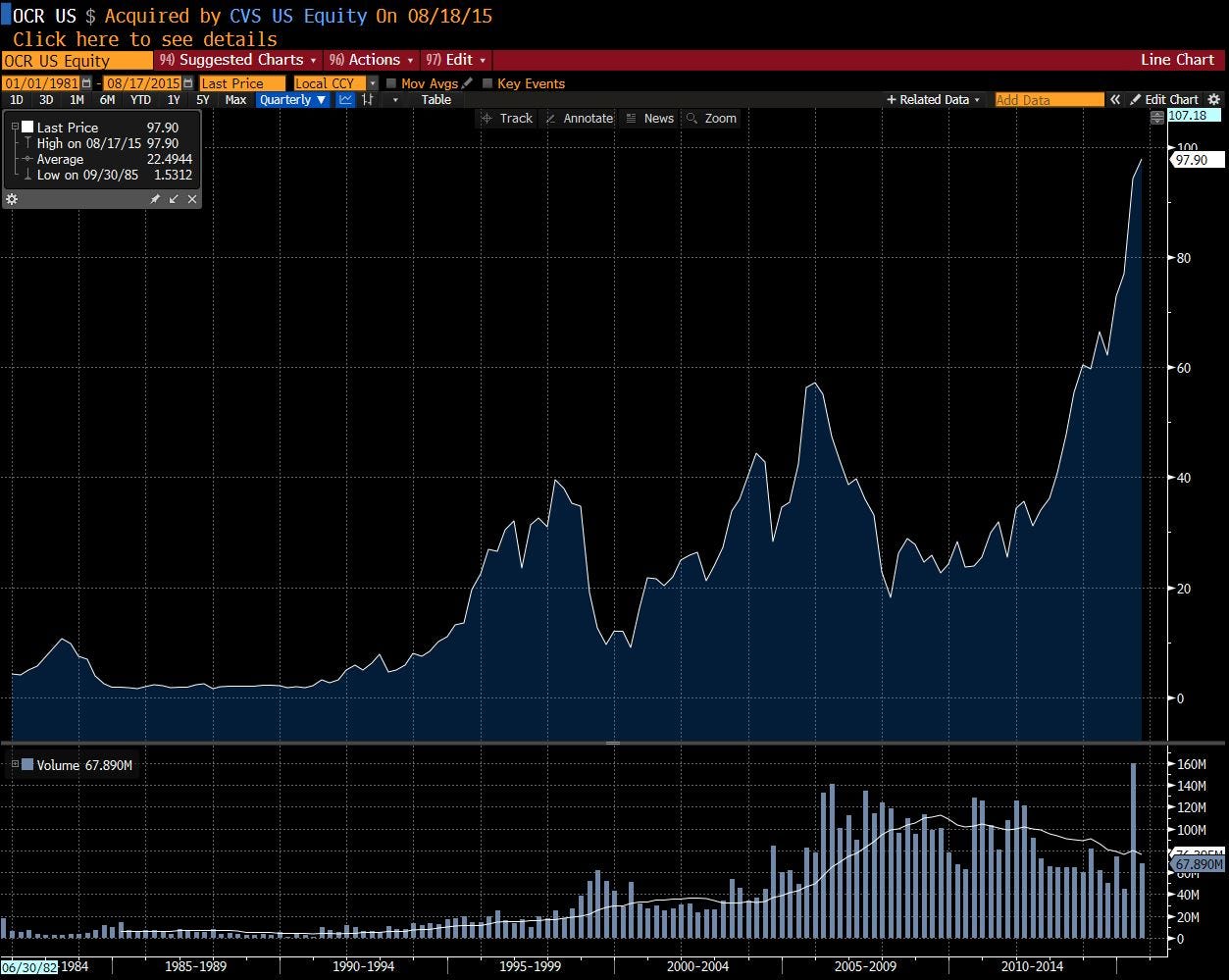
This is Omnicare’s long-term stock price chart up until the moment when Clyde McGregor presented his thesis:
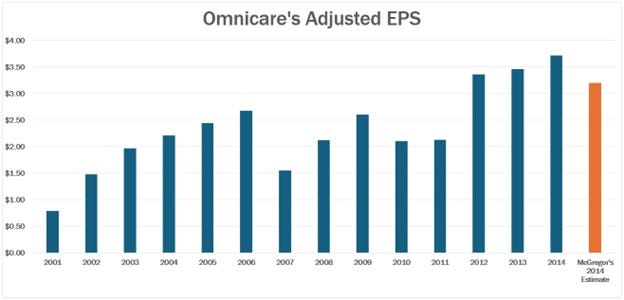
These are the highlights of Omnicare’s then-recent financials up to the point when Clyde was presenting his thesis:
Pause here. Think through the thesis and the facts and decide what you agree with, what you disagree with and whether you would invest based on the information available.
What Happened (Just the Facts)
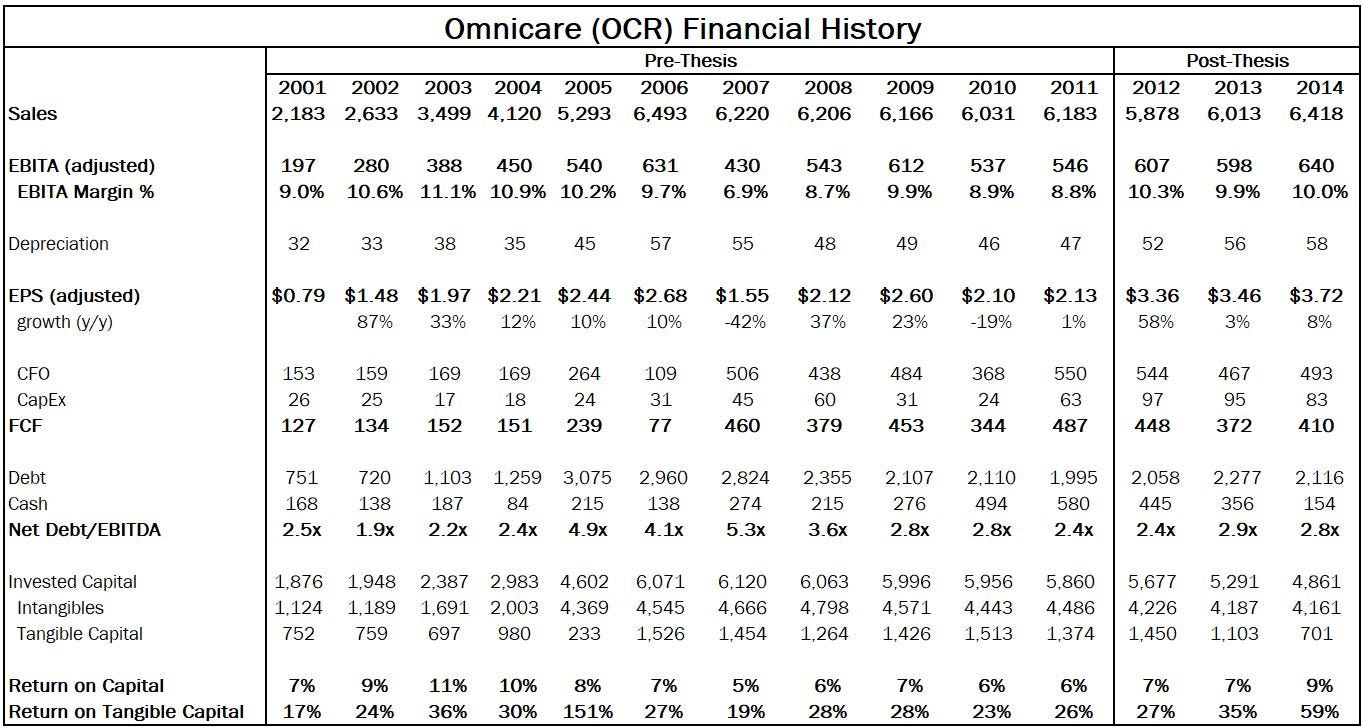
Omnicare’s financials following Clyde’s thesis were as follows:
Omnicare’s stock surpassed Clyde’s $60/share target in 2014, and was subsequently acquired by CVS in an all-cash deal for $98/share in 2015:
This week's article is free, but usually this is where only paid subscribers continue.
The Autopsy (Reasons for the Facts)
In 2013 and 2014 the company struggled with meaningfully growing sales. This was due to a combination of:
Reimbursement-related price pressure
Declines in organic volume growth
Margins did improve in 2012, consistent with Clyde’s thesis. However, given that he was presenting the thesis in November of 2012, that would have already been largely known to him. There was no further meaningful improvement in margins.
As a result, EPS did jump in 2012 above Clyde’s forecast, but remained relatively stable from that point on:
The company also continued to experience management instability. As Clyde mentioned in his thesis, the ex-McKesson CEO only stayed briefly, for a year and a half. He was then replaced by the COO, who also only lasted a couple of years and was in turn replaced from within.
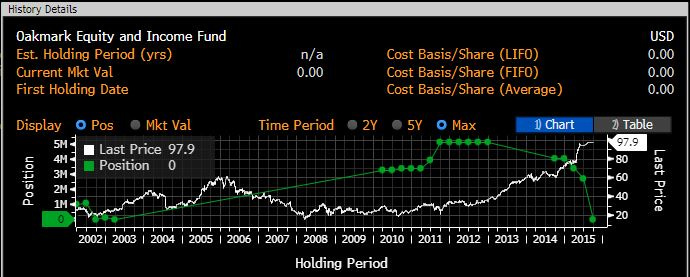
Clyde’s fund did well with its Omnicare investment, holding the shares to capture most of the upside:
The buyer, CVS, however, didn’t do well at all. You can see the troubles begin to peek through in the company’s Goodwill impairment assessments. In the 2018 Q3 form 10-Q, CVS management wrote the following:
The fair value of the LTC reporting unit exceeded its carrying value by a narrow margin of approximately 1%. During 2018, the LTC reporting unit has continued to experience challenges that have impacted management’s ability to grow the business at the rate that was originally estimated when the Company made the acquisition of Omnicare, Inc. and when the prior year annual goodwill impairment test was performed. These challenges include lower client retention rates, lower occupancy rates in skilled nursing facilities, the deteriorating financial health of numerous skilled nursing facility customers, and continued facility reimbursement pressures. In June 2018, LTC management submitted their initial budget for 2019 and updated their 2018 annual forecast which showed a deterioration in the financial results for the remainder of 2018 and in 2019, which also caused management to update their long term forecast beyond 2019.
This 1% cushion, if we can call it that, was a reduction from the prior 7% excess value reported in the 2016 Q3 form 10-Q. Something tells me that if you get your DCF valuation to show a 1% margin of safety, that perhaps you had to do some financial acrobatics to get it to come out positive at all.
Unfortunately for CVS, the bad news didn’t stop there. In the 2018 Q3 10-Q the company told shareholders that it had to take a $3.9B goodwill impairment charge due to continued underperformance at the legacy Omnicare business. The problems included lower client retention rates and deteriorating financial health at Omnicare’s customers.
I will spare you the subsequent additional impairment charges over the years and bring you straight to the final nail in the coffin. In September 2025 Omnicare filed for Chapter 11 following a $949M False Claims Act adverse judgement that stemmed from a 2015 whistleblower lawsuit alleging that Omnicare dispensed medications without valid prescriptions from 2010 to 2018 and then billed Medicare, Medicaid and TRICARE for over 3.3 million false claims.
The judge “emphasized that the violations were not only deliberate but also persisted for years despite repeated warnings and available remedies.” Ouch!
The Lessons
1. A strong business in a niche can attract strategic acquirors willing to pay a big premium if the business is useful to them and is hard to replicate.
2. In heavily-regulated industries, regulation is always a factor, frequently a negative one. Clyde didn’t see government healthcare reform as material either way to his thesis, and while perhaps he was right on that, government reimbursement pressure was consistently cited in subsequent years as a negative pressure on sales.
3. New management cannot quickly fix old, deep-rooted problems in a company’s culture. It takes many years of deliberate effort to do that, if it’s even possible, and in Omnicare’s case the revolving door of CEOs was a warning sign.
Discussion Questions:
1. How do you draw the proper lessons from an investment where you did well because of an acquisition, but that then turned out poorly for the buyer?
2. How predictable were the problems at Omnicare that ultimately led to the company’s demise?
3. How should we take into account regulatory uncertainty when investing in companies in heavily regulated industries?
It’s your turn:
In the comments, briefly share either (1) one way you will improve your investment process or (2) one checklist item you will add based on this case. Then reply to a fellow member
Join the weekly thread for deeper discussion and Q&A
See you in the comments section and the discussion thread!
A Request
Help grow our community of thoughtful investors by sending this case to one investor that you would like to see join.
About the author

Gary Mishuris, CFA is the Managing Partner and Chief Investment Officer of Silver Ring Value Partners, an investment firm that seeks to apply its intrinsic value approach to safely compound capital over the long-term. He also teaches the Value Investing Seminar at the F.W. Olin Graduate School of Business.
Gary, Is the case study supposed to be the assignment this week? I didn't see any questions as in the past.
If the acquisition was unexpected, perhaps we should consider whether it is in line with our estimate of fair value. If not, maybe you just got lucky. Further, we could see if subsequent business performance (if disclosed) was in line with our estimates and draw lessons based on that. The acquisition itself should not be given much weight unless it was a core component of the thesis