


If you haven’t read the guide to the 10-Minute Investment Autopsy series, you can find it here. You will get the most out of each case if you:
Pause after the “Original Thesis” section and think about what you would have done
Engage with the discussion questions and other members in the weekly thread designed to help you further improve your investing process
With that out of the way, let’s jump into our first case study, Lear Corp.
The Original Thesis
Who: Richard Pzena
When: September 2005
What: Lear Corporation (ticker: LEA)
The Thesis:
Richard Pzena presented Lear Corp (LEA) to Joel Greenblatt’s MBA class at Columbia Business School as an attractive investment that his firm owned at that time. His thesis was:
Lear is an auto supplier that sells car seats (2/3rds of sales) and Interior Systems and Electronic & Electrical components.
The car seat business is a good business, while the rest is more commodity-like
Richard believes that Lear is a good business because it’s a duopoly in car seats with high switching costs which outweighs the high customer concentration and the risk from meaningful debt.
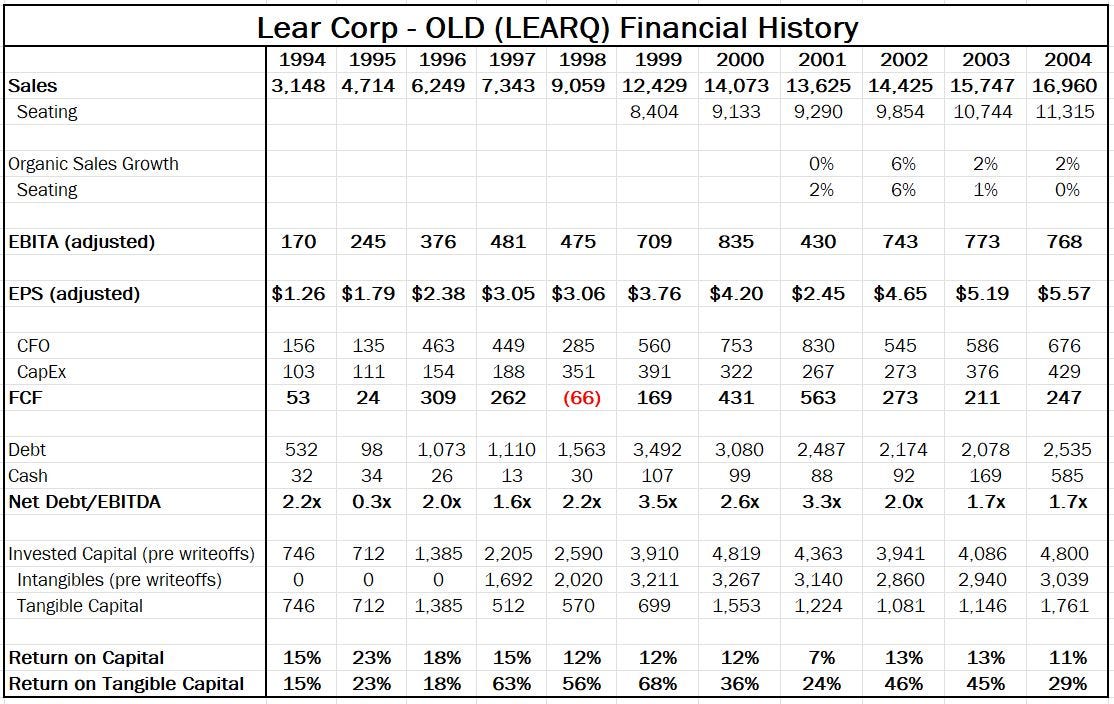
This assessment is supported by high, 20%-30%, Return on Tangible Capital over the last decade.
Richard estimates that normalized sales are around $17B and normalized margins around 5.3% based on the average of the prior two years.
Estimates normalized, mid-cycle EPS as $7.30 ($170M interest expenses, 33% tax rate, 67M shares), but because he believes that the Interior segment should have no value ascribed to it, supported by management’s recent large goodwill write-down, he reduced it to $6/sh.
The current problems compressing margins and leading management to guide for $3.50/sh in EPS for 2006 are temporary.
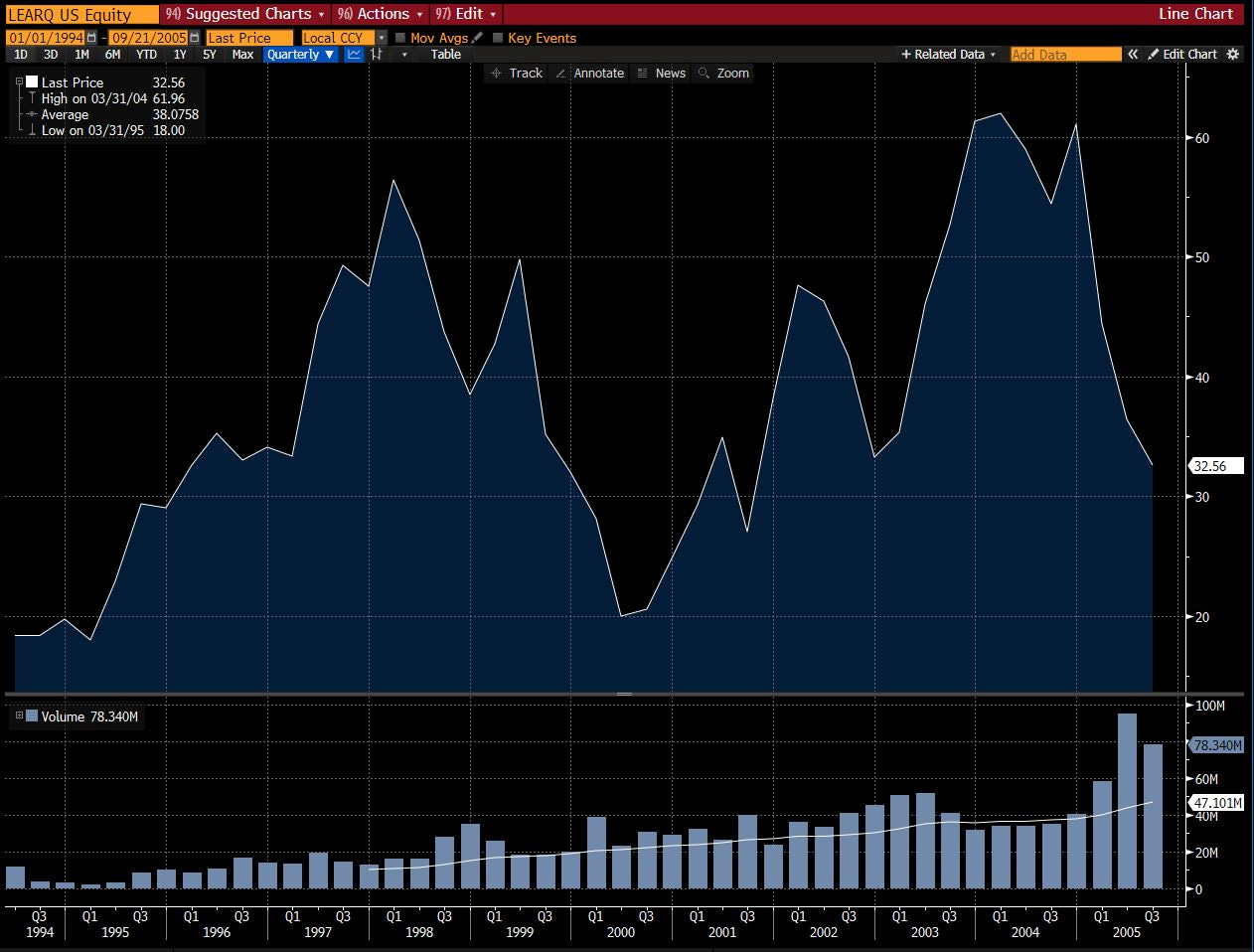
At the price of $33/share the stock is meaningfully undervalued with a P/E of just over 5x.
The above is conservative since it assumes no growth and zero value for the Interior segment.
Estimates fair value at $84 (14 P/E x $6 EPS) leading to attractive risk/reward.
“I wouldn’t sell it unless it ran tomorrow from $33 to $75. I do think it is one of the cheapest stocks out there, for good reasons. […] The fundamentals are not deteriorating. If things get better, the stock will rise a lot, but if conditions don’t improve, then you won’t lose much. Even if GM & Ford go bankrupt, they will still make cars.”
This is Lear’s long-term stock price chart up until the moment when Richard Pzena presented his thesis:
These are the highlights of Lear’s then-recent financials up to the point when Richard was presenting his thesis:
Pause here. Think through the thesis and the facts and decide what you agree with, what you disagree with and whether you would invest based on the information available.
What Happened (Just the Facts)
Lear’s financials following Richard’s presentation were as follows:
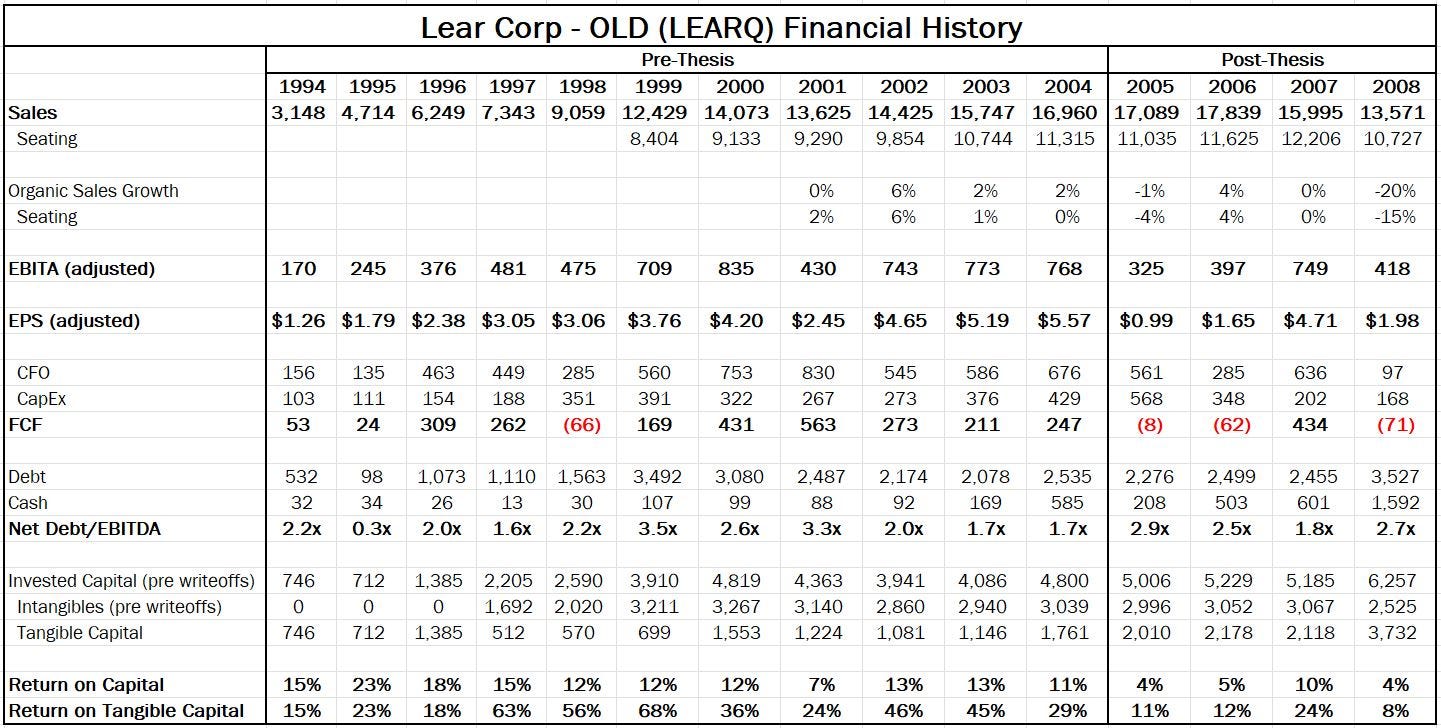
In an interesting development in the Spring of 2007, Carl Icahn made a $36/share offer to acquire Lear, which was initially accepted by the Board. Pzena Investment Management led the opposition to the offer, arguing that it undervalued the company. The deal was ultimately rejected by shareholders.
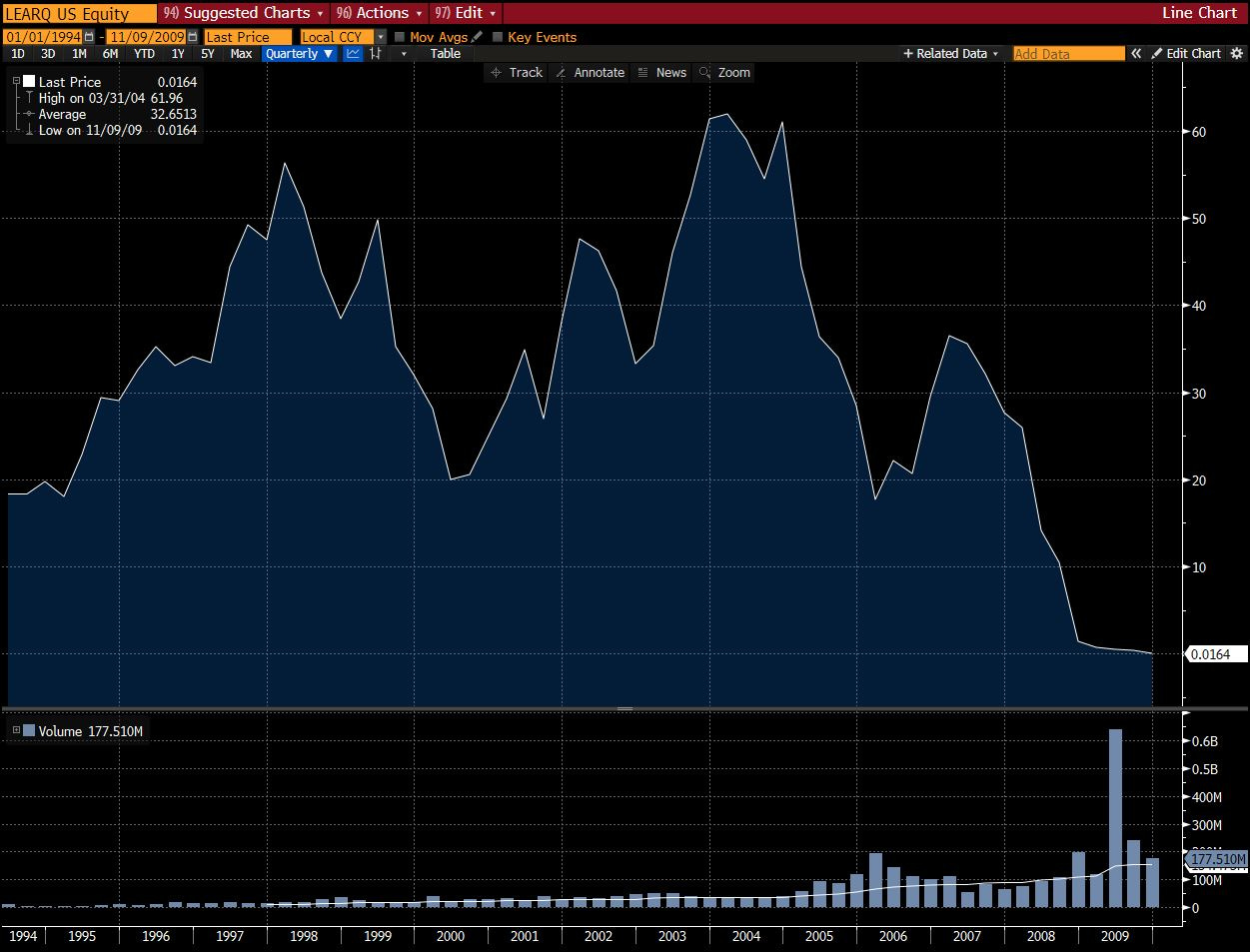
The company filed for bankruptcy in 2009 due to the severe recession in the U.S. which significantly reduced car demand and led to the bankruptcy of its largest customers. Equity shareholders were completely wiped out:
There is a lot more to the case:
The Autopsy - the reasons for what happened
The Lessons that you can apply to your own investing
Discussion Questions for you to think about and discuss with other thoughtful investors in the weekly case thread